(zavegepant)
14 CLINICAL STUDIES
14 CLINICAL STUDIES
The efficacy of ZAVZPRET for the acute treatment of migraine with or without aura in adults was demonstrated in two randomized, double-blind, placebo-controlled trials (Study 1 and Study 2). In both studies, patients were instructed to treat a migraine of moderate to severe headache pain intensity. Rescue medication (i.e., NSAIDs, acetaminophen, and/or an antiemetic) was allowed 2 hours after the initial treatment. Other forms of rescue medication such as triptans were not allowed within 48 hours of initial treatment. In Study 1 and Study 2, 13.4% and 13.6% of patients were taking preventive medications for migraine at baseline, respectively. None of the patients were on concomitant preventive medication that act on the CGRP pathway.
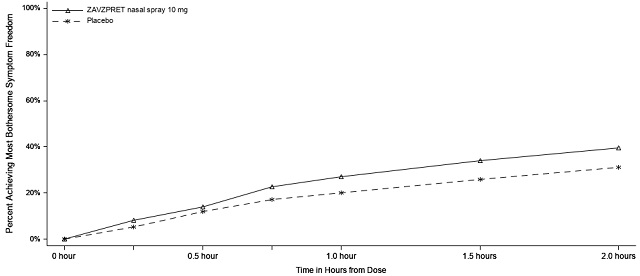
In Study 1 (NCT04571060), patients were randomized to receive a single dose of ZAVZPRET 10 mg (N=623) or placebo (N=646). Efficacy was demonstrated with ZAVZPRET 10 mg by an effect on the coprimary endpoints of pain freedom and most bothersome symptom (MBS) freedom at 2 hours after a single dose, compared to placebo. Pain freedom was defined as a reduction of moderate or severe headache pain to no headache pain, and MBS freedom was defined as the absence of the self-identified MBS (i.e., photophobia, phonophobia, or nausea). The most common MBS reported before dosing was photophobia (55%), followed by nausea (28%), and phonophobia (16%).
In Study 1, the percentage of patients achieving headache pain freedom and MBS freedom 2 hours after a single dose was statistically significantly greater in patients who received ZAVZPRET compared to those who received placebo (Table 2).
Table 2: Efficacy Endpoints in Study 1
ZAVZPRET 10 mg | Placebo | |
Pain Free at 2 hours | ||
n/N* | 147/623 | 96/646 |
% Responders | 23.6 | 14.9 |
Difference from placebo (%) | 8.8 | |
p-value | <0.001 | |
MBS† Free at 2 hours | ||
n/N* | 247/623 | 201/646 |
% Responders | 39.6 | 31.1 |
Difference from placebo (%) | 8.7 | |
p-value | 0.001 | |
Figures 1 and 2 present the percentage of patients achieving migraine pain freedom and MBS freedom within 2 hours following treatment in Study 1.
Figure 1: Percentage of Patients Achieving Pain Freedom within 2 Hours in Study 1
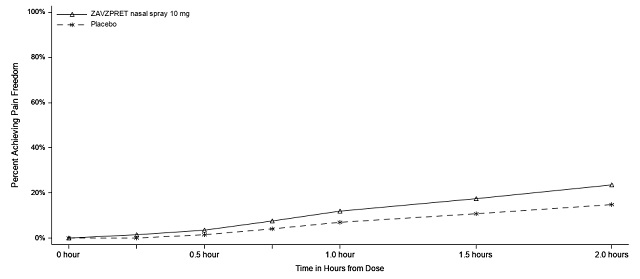
Figure 2: Percentage of Patients Achieving MBS Freedom within 2 Hours in Study 1
In Study 1, statistically significant effects of ZAVZPRET compared to placebo were demonstrated for the additional efficacy endpoints of pain relief at 2 hours post-dose, return to normal function at 2 hours post-dose, sustained pain freedom from 2 to 48 hours post-dose (Table 3), and phonophobia and photophobia freedom at 2 hours post-dose. Pain relief was defined as a reduction in migraine pain from moderate or severe severity to mild or none. The measurement of the percentage of patients reporting normal function at two hours after dosing was derived from a single item questionnaire, asking patients to select one response on a 4-point scale: normal function, mild impairment, severe impairment, or required bedrest.
Table 3: Additional Efficacy Endpoints in Study 1
ZAVZPRET 10 mg | Placebo | |
Pain Relief at 2 hours | ||
n/N* | 366/623 | 321/646 |
% Responders | 58.7 | 49.7 |
Difference from placebo (%) | 9.0 | |
p-value | 0.001 | |
Percentage of Patients Reporting Normal Function at 2 hours† | ||
n/N* | 204/570 | 152/593 |
% Responders | 35.8 | 25.6 |
Difference from placebo (%) | 10.2 | |
p-value | <0.001 | |
Sustained Pain Freedom from 2 to 48 hours | ||
n/N* | 77/623 | 56/646 |
% Responders | 12.4 | 8.7 |
Difference from placebo (%) | 3.7 | |
p-value | 0.031 | |
The incidence of photophobia and phonophobia was reduced following administration of ZAVZPRET 10 mg as compared to placebo.
In Study 2 (NCT03872453), patients were randomized to receive a single dose of ZAVZPRET 10 mg (n=391) or placebo (n=401).
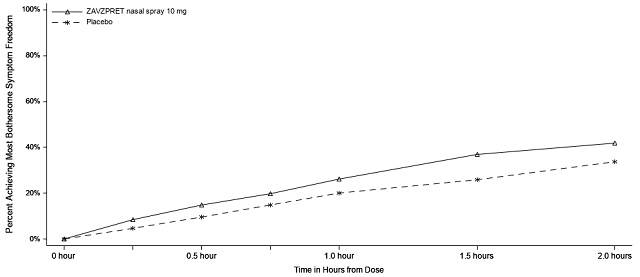
In Study 2, statistically significant efficacy was demonstrated with ZAVZPRET 10 mg by an effect on the coprimary endpoints of pain freedom and most bothersome symptom (MBS) freedom at 2 hours after a single dose, compared to placebo. Pain freedom was observed in 22.5% of patients receiving ZAVZPRET and 15.5% of patients receiving placebo (p-value = 0.011). MBS freedom was observed in 41.9% of patients receiving ZAVZPRET and 33.7% of patients receiving placebo (p-value = 0.016). The most common MBS reported before dosing was photophobia (53%), followed by nausea (31%), and phonophobia (15%).
Table 4: Efficacy Endpoints in Study 2
ZAVZPRET 10 mg | Placebo | |
Pain Free at 2 hours | ||
n/N* | 88/391 | 62/401 |
% Responders | 22.5 | 15.5 |
Difference from placebo (%) | 7.0 | |
p-value | 0.011 | |
MBS† Free at 2 hours | ||
n/N* | 164/391 | 135/401 |
% Responders | 41.9 | 33.7 |
Difference from placebo (%) | 8.3 | |
p-value | 0.016 | |
Figure 3: Percentage of Patients Achieving Pain Freedom within 2 Hours in Study 2
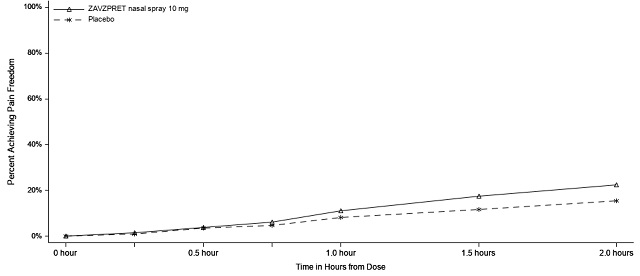
Figure 4: Percentage of Patients Achieving MBS Freedom within 2 Hours in Study 2
PATIENT PACKAGE INSERT
Patient Package Insert
PATIENT INFORMATION (zavegepant) nasal spray |
What is ZAVZPRET?
ZAVZPRET is a prescription medicine used in adults for the acute treatment of migraine attacks with or without aura.
ZAVZPRET is not used to prevent migraine attacks.
It is not known if ZAVZPRET is safe and effective in children.
Do not use ZAVZPRET if you are:
- •
- allergic to zavegepant, or any of the ingredients in ZAVZPRET.
See the end of this leaflet for a complete list of ingredients in ZAVZPRET.
Before you use ZAVZPRET, tell your healthcare provider about all of your medical conditions, including if you:
- •
- have high blood pressure.
- •
- have circulation problems in your fingers and toes.
- •
- have kidney problems.
- •
- have liver problems.
- •
- are pregnant or plan to become pregnant. It is not known if ZAVZPRET will harm your unborn baby.
- •
- are breastfeeding or plan to breastfeed. It is not known whether ZAVZPRET passes into your breast milk. Talk with your healthcare provider about the best way to feed your baby if you use ZAVZPRET.
Tell your healthcare provider about all the medicines you take, including prescription and over-the-counter medicines, vitamins, and herbal supplements.
How should I use ZAVZPRET?
- •
- Use ZAVZPRET exactly how your healthcare provider tells you to use it.
- •
- See the Instructions for Use for complete information on how to use ZAVZPRET nasal spray.
- •
- ZAVZPRET is given in the nose (nasal) only.
- •
- Each ZAVZPRET only sprays 1 time and cannot be reused. Do not test or prime the nasal spray before use.
- •
- Each dose of ZAVZPRET is provided in an individual pack. Use all of the medicine in 1 pack for a complete dose.
- •
- The recommended dose is 10 mg given as a single spray in one nostril.
- •
- Do not use more than 1 spray (10 mg) of ZAVZPRET nasal spray in a 24-hour period.
- •
- It is not known if it is safe to use more than 8 sprays (doses) of ZAVZPRET in 30 days.
- •
- Avoid using intranasal decongestants with ZAVZPRET. If you have to use an intranasal decongestant, use it at least 1 hour after using ZAVZPRET.
What are the possible side effects of ZAVZPRET?
ZAVZPRET may cause serious side effects including:
- •
- Allergic reactions. Allergic reactions, including trouble breathing, hives, and swelling of the face, can happen after you use ZAVZPRET. Call your healthcare provider or get emergency help right away if you have any of the following symptoms, which may be part of an allergic reaction:
- o
- swelling of the face, mouth, tongue, or throat
- o
- trouble breathing
- o
- rash
- o
- hives
- •
- High blood pressure. High blood pressure or worsening of high blood pressure can happen after you use ZAVZPRET. Contact your healthcare provider if you have an increase in blood pressure.
- •
- Raynaud’s phenomenon. A type of circulation problem can worsen or happen after you use ZAVZPRET. Raynaud’s phenomenon can lead to your fingers or toes feeling numb, cool, or painful, or changing color from pale, to blue, to red. Contact your healthcare provider if these symptoms occur.
The most common side effects of ZAVZPRET are:
- •
- unusual taste
- •
- nausea
- •
- nasal discomfort
- •
- vomiting
These are not the only possible side effects of ZAVZPRET.
Call your doctor for medical advice about side effects. You may report side effects to FDA at 1-800-FDA-1088.
How should I store ZAVZPRET?
- •
- Store ZAVZPRET in the blister package that it comes in.
- •
- Store ZAVZPRET at room temperature between 68°F to 77°F (20°C to 25°C).
- •
- Do not freeze.
Keep ZAVZPRET and all medicines out of the reach of children.
General information about the safe and effective use of ZAVZPRET:
Medicines are sometimes prescribed for purposes other than those listed in a Patient Information leaflet. Do not use ZAVZPRET for a condition for which it was not prescribed. Do not give ZAVZPRET to other people, even if they have the same symptoms that you have. It may harm them. You can ask your pharmacist or healthcare provider for information about ZAVZPRET that is written for health professionals.
What are the ingredients in ZAVZPRET?
Active ingredients in ZAVZPRET: zavegepant
Inactive ingredients in ZAVZPRET: dextrose, hydrochloric acid, sodium hydroxide, and succinic acid in water for injection.
For more information, go to www.zavzpret.com or call 1-800-438-1985.
LAB-1545-3.0
This Patient Information has been approved by the US. Food and Drug Administration | 8/2025 |
Additional Resources
Chat online with Pfizer Medical Information regarding your inquiry on a Pfizer medicine or vaccine.
Speak with a Pfizer Medical Information Professional regarding your Pfizer medicine or vaccine inquiry.
Available 9AM-5PM ET Monday to Friday; excluding holidays.
Submit a medical question for a Pfizer medicine or a vaccine.
The submission will be reviewed during our standard business hours.
To report an adverse event related to a Pfizer product and you are not part of a clinical trial* for this medication, click the link below to submit your information:
Pfizer Safety Reporting Site
*If you are involved in a clinical trial for either product, adverse events should be reported to your coordinating study site.
If you cannot use the above website to report an adverse event related to a Pfizer medication, please call (800) 438-1985.
You may also contact the U.S. Food and Drug Administration (FDA) directly to report adverse events or product quality concerns either online at www.fda.gov/medwatch or by calling (800) 332-1088.