(pegvisomant with PREFILLED DILUENT SYRINGE)

Prescribing Information
Download Prescribing Information

11 DESCRIPTION

11 DESCRIPTION

Pegvisomant is an analog of human growth hormone (GH) of recombinant DNA origin that acts as a GH receptor antagonist.

It contains 191 amino acid residues. The molecular weight of pegvisomant is 22 kDa. The molecular weight of the PEG portion of pegvisomant is approximately 5 kDa. The predominant molecular weights of pegvisomant are thus approximately 42, 47, and 52 kDa. The schematic shows the amino acid sequence of the pegvisomant protein (PEG polymers are shown attached to the 5 most probable attachment sites). Pegvisomant is synthesized by a specific strain of Escherichia coli bacteria that has been genetically modified by the addition of a plasmid that carries a gene for GH receptor antagonist.
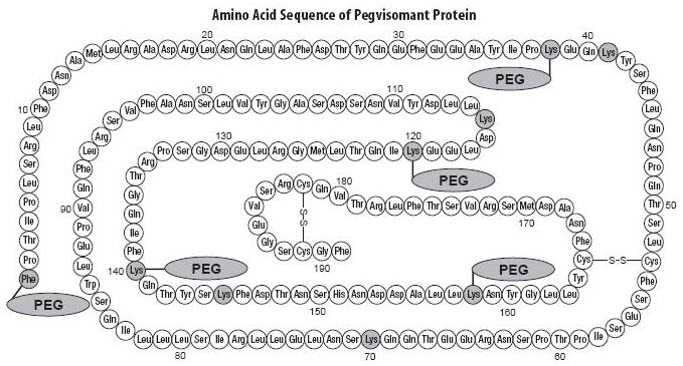
Chemical Structure

Stippled residues indicate PEG attachment sites (Phe1, Lys38, Lys41, Lys70, Lys115, Lys120, Lys140, Lys145, Lys158)

Shown below are the amino acid substitutions in pegvisomant, relative to human GH.

hGHPegvisomant

His18

Asp18

Ala21

Asn21

Gly120

Lys120

Arg167

Asn167

Lys168

Ala168

Asp171

Ser171

Lys172

Arg172

Glu174

Ser174

Ile179

Thr179

SOMAVERT (pegvisomant) for injection is a sterile, white lyophilized powder intended for subcutaneous injection after reconstitution. SOMAVERT is supplied in packages that include a single-dose prefilled syringe containing 1 mL of Sterile Water for Injection, USP, that is a sterile, nonpyrogenic preparation of water for injection that contains no bacteriostat, antimicrobial agent, or added buffer, to be used as a diluent.

SOMAVERT is available in single-dose sterile vials containing 10 mg, 15 mg, 20 mg, 25 mg or 30 mg of pegvisomant. SOMAVERT 10 mg, 15 mg, and 20 mg vials also contain glycine (1.36 mg), mannitol (36 mg), sodium dihydrogen phosphate monohydrate (0.36 mg), and sodium phosphate dibasic anhydrous (1.04 mg). After reconstitution with 1 mL of Water for Injection, USP, the resulting concentration is 10 mg/mL, 15 mg/mL and 20 mg/mL, respectively, with a pH of 7.1 – 7.7.

SOMAVERT 25 mg vial also contains glycine (1.7 mg), mannitol (45 mg), sodium dihydrogen phosphate monohydrate (0.45 mg), and sodium phosphate dibasic anhydrous (1.3 mg). After reconstitution with 1 mL of Water for Injection, USP, the resulting concentration is 25 mg/mL with a pH of 7.1 – 7.7.

SOMAVERT 30 mg vial also contains glycine (2.04 mg), mannitol (54 mg), sodium dihydrogen phosphate monohydrate (0.54 mg), and sodium phosphate dibasic anhydrous (1.56 mg). After reconstitution with 1 mL of Water for Injection, USP, the resulting concentration is 30 mg/mL with a pH of 7.1 – 7.7.

Medication Guide

MEDICATION GUIDE

This Patient Information has been approved by the U.S. Food and Drug Administration.

Revised: 7/2023

PATIENT INFORMATION
SOMAVERT (SOM-ah-vert)
(pegvisomant)
for injection, for subcutaneous use

What is SOMAVERT?
SOMAVERT is a prescription medicine used to treat people who have too much growth hormone (acromegaly). SOMAVERT is used to treat people who are not able to be treated or have not already been helped by surgery or radiation.
It is not known if SOMAVERT is safe and effective in children.

Before you use SOMAVERT, tell your healthcare provider about all of your medical conditions, including if you:

are allergic to pegvisomant or any of the ingredients in SOMAVERT. Do not take SOMAVERT if you are allergic to pegvisomant or any of the ingredients in SOMAVERT. See the end of this Patient Information leaflet for a complete list of ingredients in SOMAVERT.
have diabetes.
have or have had liver problems.
are pregnant or plan to become pregnant. It is not known if SOMAVERT will harm your unborn baby. Tell your healthcare provider if you become pregnant while using SOMAVERT.
are breastfeeding or plan to breastfeed. It is not known if SOMAVERT passes into your breast milk. You and your healthcare provider should decide how you will feed your baby if you take SOMAVERT.

Tell your healthcare provider about all the medicines you take, including prescription and over-the-counter medicines, vitamins, and herbal supplements.
SOMAVERT may affect the way other medicines work, and other medicines may affect how SOMAVERT works.
Especially tell your healthcare provider if you take:

insulin or other medicines used to treat diabetes.
narcotics (opioid medicines). Your healthcare provider may change your dose of SOMAVERT if you take opioids.

If you are not sure, ask your healthcare provider or pharmacist whether you take these medicines.

How should I use SOMAVERT?

Read the Instructions for Use at the end of this Patient Information for information about the right way to use SOMAVERT.
Your healthcare provider should do blood tests to check your liver and insulin-like growth factor-1 (IGF-1) levels before you start and while you use SOMAVERT. Your healthcare provider may need to change your dose of SOMAVERT.
SOMAVERT is given 1 time each day as an injection under your skin (subcutaneous). Some people may need to give 2 injections for their dose each day. Your healthcare provider will tell you if you need to give 2 injections for your dose.
Your first injection of SOMAVERT should be given by your healthcare provider.
Your healthcare provider will teach you or your caregiver how to use SOMAVERT.
If you use too much SOMAVERT, call your healthcare provider right away.
If you miss a dose of SOMAVERT, just take the next dose at the regular time. Do not take 2 doses at the same time. If you are not sure about your dosing, ask your healthcare provider.

What are the possible side effects of SOMAVERT?
SOMAVERT may cause serious side effects, including:

changes in your blood sugar level. Your healthcare provider may change your dose of diabetes medicine while you take SOMAVERT.
liver problems. Stop injecting SOMAVERT right away and call your healthcare provider if you have any of the following symptoms of liver problems:
o
yellowing of your eyes (jaundice)
o
dark, amber-colored urine
o
feeling very tired (fatigue or exhaustion)
o
nausea and vomiting
o
pain in your stomach (abdomen)
o
generalized swelling
o
bruising easily
skin thickening at your injection site that could lead to lumps (lipohypertrophy)
allergic reactions. Call your healthcare provider right away if you have any of the following symptoms of a serious allergic reaction:
o
swelling of your face, tongue, lips, or throat
o
wheezing or trouble breathing
o
skin rash, redness, or swelling
o
severe itching
o
dizziness or fainting

The most common side effects of SOMAVERT include:

pain
infection
nausea
flu syndrome
injection site reaction
diarrhea
abnormal liver tests. If your liver test results are too high, you may have to have more frequent liver tests

These are not all of the possible side effects of SOMAVERT. For more information, ask your healthcare provider or pharmacist.
Tell your healthcare provider if you have any side effect that bothers you or that does not go away.
Call your doctor for medical advice about side effects. You may report side effects to FDA at 1-800-FDA-1088.

How should I store SOMAVERT?

Before you mix the SOMAVERT powder and the liquid:
o
Store SOMAVERT in a refrigerator at 36°F to 46°F (2°C to 8°C).
o
The One Day Package and intermediate cartons in the 30-Day Package containing the SOMAVERT vials, may be stored at room temperature up to 77°F (25°C) for a single period of up to 30 days.
o
In the space provided on the carton, record the date when the carton was removed from the refrigerator and the discard date (30 days after removal from the refrigerator).
o
After the carton has been stored at room temperature, it should not be placed back into the refrigerator. If not used within 30 days at room temperature, the vials should be thrown away.
Throw away the SOMAVERT vials after the expiration date printed on the carton or the discard date, whichever is sooner.
The prefilled syringes maybe stored at a temperature up to 86°F (30°C) until the expiration date printed on the carton. After that time, they should be thrown away.
Do not freeze SOMAVERT.
Read the Instructions for Use for the right way to mix SOMAVERT.
After you mix the SOMAVERT powder and liquid:
o
Keep the mixed SOMAVERT at room temperature between 59°F to 77°F (15°C to 25°C).
o
Keep SOMAVERT inside the vial or the syringe until you are ready to inject it.
o
You must use the mixed SOMAVERT immediately after you mix it.
o
If you have not used the mixed SOMAVERT immediately, throw it away.

Keep SOMAVERT and all medicines out of the reach of children.

General information about the safe and effective use of SOMAVERT.
Medicines are sometimes prescribed for purposes other than those listed in a Patient Information leaflet. Do not use SOMAVERT for a condition for which it was not prescribed. Do not give SOMAVERT to other people, even if they have the same symptoms that you have. It may harm them.
This Patient Information summarizes the most important information about SOMAVERT. If you would like more information, talk with your healthcare provider. You can ask your pharmacist or healthcare provider for information about SOMAVERT that is written for health professionals.

What are the ingredients in SOMAVERT?
Active ingredient: pegvisomant, including polyethylene glycol
Inactive ingredients: glycine, mannitol, sodium dihydrogen phosphate monohydrate, and sodium phosphate dibasic anhydrous.

Logo

U.S. License No. 1216


LAB-0783-4.0

For more information, go to www.SOMAVERT.com or call 1-800-645-1280.

Additional Resources

Chat online with Pfizer Medical Information regarding your inquiry on a Pfizer medicine or vaccine.

Speak with a Pfizer Medical Information Professional regarding your Pfizer medicine or vaccine inquiry.

Available 9AM-5PM ET Monday to Friday; excluding holidays.


Submit a medical question for a Pfizer medicine or a vaccine. 

The submission will be reviewed during our standard business hours.

To report an adverse event related to a Pfizer product and you are not part of a clinical trial* for this medication, click the link below to submit your information: 
Pfizer Safety Reporting Site

*If you are involved in a clinical trial for either product, adverse events should be reported to your coordinating study site.

If you cannot use the above website to report an adverse event related to a Pfizer medication, please call (800) 438-1985.

You may also contact the U.S. Food and Drug Administration (FDA) directly to report adverse events or product quality concerns either online at www.fda.gov/medwatch or by calling (800) 332-1088.