(rimegepant)
14 CLINICAL STUDIES
14 CLINICAL STUDIES
14.1 Acute Treatment of Migraine
The efficacy of NURTEC ODT for the acute treatment of migraine with and without aura in adults was demonstrated in a randomized, double-blind, placebo-controlled trial: Study 1 (NCT03461757). Patients in the study were randomized to receive 75 mg of NURTEC ODT (N=732) or placebo (N=734). Patients were instructed to treat a migraine of moderate to severe headache pain intensity. Rescue medication (i.e., NSAIDs, acetaminophen, and/or an antiemetic) was allowed 2 hours after the initial treatment. Other forms of rescue medication such as triptans were not allowed within 48 hours of initial treatment. Approximately 14% of patients were taking preventive medications for migraine at baseline. None of the patients in Study 1 were on concomitant preventive medication that act on the CGRP pathway.
The primary efficacy analyses were conducted in patients who treated a migraine with moderate to severe pain. NURTEC ODT 75 mg demonstrated an effect on pain freedom and most bothersome symptom (MBS) freedom at two hours after dosing, compared to placebo. Pain freedom was defined as a reduction of moderate or severe headache pain to no headache pain, and MBS freedom was defined as the absence of the self-identified MBS (i.e., photophobia, phonophobia, or nausea). Among patients who selected an MBS, the most commonly selected symptom was photophobia (54%), followed by nausea (28%), and phonophobia (15%).
In Study 1, the percentage of patients achieving headache pain freedom and MBS freedom two hours after a single dose was statistically significantly greater in patients who received NURTEC ODT compared to those who received placebo (Table 1).
| Study 1 | ||
|---|---|---|
| NURTEC ODT 75 mg | Placebo | |
| ||
Pain Free at 2 hours | ||
n/N* | 142/669 | 74/682 |
% Responders | 21.2 | 10.9 |
Difference from placebo (%) | 10.3 | |
p-value | <0.001 | |
MBS Free at 2 hours | ||
n/N* | 235/669 | 183/682 |
% Responders | 35.1 | 26.8 |
Difference from placebo (%) | 8.3 | |
p-value | 0.001 | |
Figure 1 presents the percentage of patients achieving migraine pain freedom within 2 hours following treatment in Study 1.
Figure 1: Percentage of Patients Achieving Pain Freedom within 2 Hours in Study 1
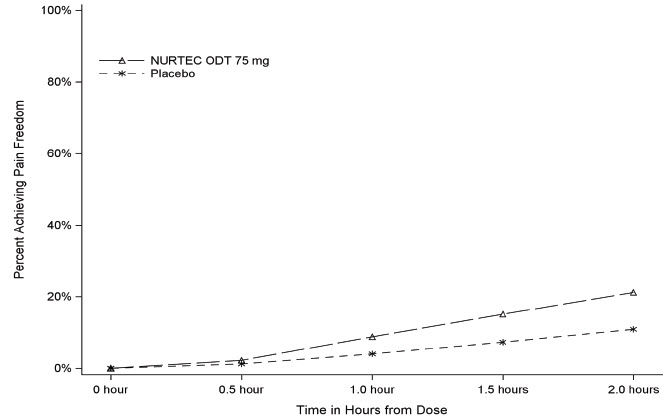
Figure 2 presents the percentage of patients achieving MBS freedom within 2 hours in Study 1.
Figure 2: Percentage of Patients Achieving MBS Freedom within 2 Hours in Study 1

In Study 1, statistically significant effects of NURTEC ODT compared to placebo were demonstrated for the additional efficacy endpoints of pain relief at 2 hours, sustained pain freedom 2-48 hours, use of rescue medication within 24 hours, and the percentage of patients reporting normal function at two hours after dosing (Table 2). Pain relief was defined as a reduction in migraine pain from moderate or severe severity to mild or none. The measurement of the percentage of patients reporting normal function at two hours after dosing was derived from a single item questionnaire, asking patients to select one response on a 4-point scale; normal function, mild impairment, severe impairment, or required bedrest.
| Study 1 | ||
|---|---|---|
| NURTEC ODT 75 mg | Placebo | |
Pain Relief at 2 hours | ||
n/N* | 397/669 | 295/682 |
% Responders | 59.3 | 43.3 |
Difference from placebo | 16.1 | |
p-value | <0.001 | |
Sustained Pain Freedom 2-48 hours | ||
n/N* | 90/669 | 37/682 |
% Responders | 13.5 | 5.4 |
Difference from placebo | 8.0 | |
p-value | <0.001 | |
Use of Rescue Medication within 24 hours† | ||
n/N* | 95/669 | 199/682 |
% Responders | 14.2 | 29.2 |
Difference from placebo | -15.0 | |
p-value | <0.001 | |
Percentage of Patients Reporting Normal Function at 2 hours | ||
n/N* | 255/669 | 176/682 |
% Responders | 38.1 | 25.8 |
Difference from placebo | 12.3 | |
p-value | <0.001 | |
The incidence of photophobia and phonophobia was reduced following administration of NURTEC ODT 75 mg as compared to placebo.
14.2 Preventive Treatment of Episodic Migraine
The efficacy of NURTEC ODT for the preventive treatment of episodic migraine in adults was demonstrated in one randomized, double-blind, placebo-controlled trial of a different oral dosage form of rimegepant (Study 2; NCT03732638).
Study 2 enrolled adult patients with at least a 1-year history of migraine (with or without aura). Patients experienced an average of 10.9 headache days during the 28-day observational period, which included an average of 10.2 migraine days, prior to randomization into the trial. Patients were randomized to receive every other day dosing of rimegepant 75 mg (N=373) or placebo (N=374) for 12 weeks. Patients were allowed to use acute headache treatments (i.e., triptans, NSAIDs, acetaminophen, antiemetics, muscle relaxants, and aspirin) as needed. Approximately 10% of patients were taking one preventive medication for migraine at baseline. The use of a concomitant medication that acts on the CGRP pathway was not permitted for either the acute or preventive treatment of migraine.
The study excluded patients with myocardial infarction, acute coronary syndrome, percutaneous coronary intervention, cardiac surgery, stroke, or transient ischemic attack within six months of screening.
The primary efficacy endpoint for Study 2 was the change from baseline in the mean number of monthly migraine days (MMDs) during Weeks 9 through 12 of the double-blind treatment phase.
The percentage of patients who achieved at least a 50% reduction from baseline in moderate to severe MMDs during Weeks 9 through 12 of the double-blind treatment phase compared to placebo was also evaluated. Rimegepant 75 mg dosed every other day demonstrated statistically significant improvements for these efficacy endpoints compared to placebo, as summarized in Table 3.
| Rimegepant 75 mg Every Other Day | Placebo Every Other Day | |
|---|---|---|
Monthly Migraine Days (MMD), Weeks 9-12 | N=348 | N=347 |
Change from baseline | -4.3 | -3.5 |
Change from placebo | -0.8 | |
p-value | 0.010 | |
≥ 50% Responders (Moderate to Severe MMDs), Weeks 9-12 | N=348 | N=347 |
% Responders | 49.1 | 41.5 |
Difference from placebo | 7.6 | |
p-value | 0.044 |
Figure 3: Change from Baseline in Monthly Migraine Days in Study 2a
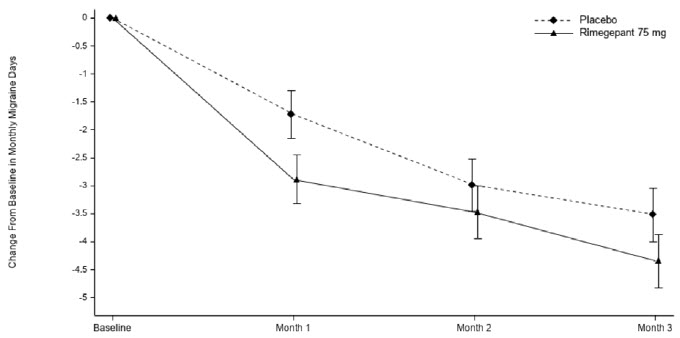
aLeast-square means and 95% confidence intervals are presented.
Figure 4: Distribution of Change from Baseline in Mean Monthly Migraine Days at Month 3 by Treatment Group in Study 2a
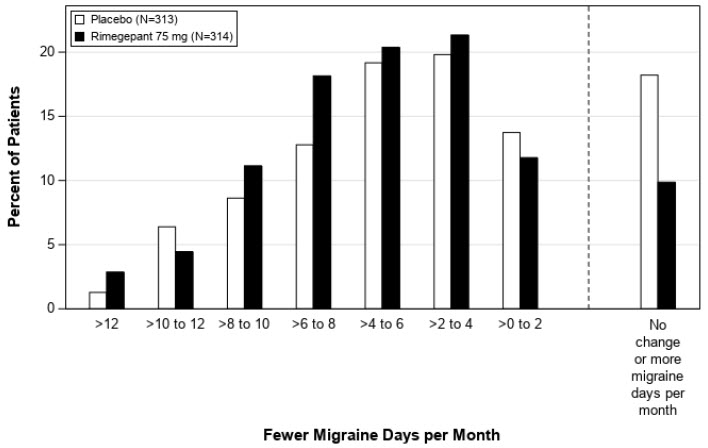
aFigure excludes patients with missing data.
MEDICATION GUIDE
| This Patient Information has been approved by the U.S. Food and Drug Administration Revised: 4/2026 |
PATIENT INFORMATION NURTEC® ODT (NUR-tek) (rimegepant) orally disintegrating tablets (ODT), for sublingual or oral use |
What is NURTEC ODT? NURTEC ODT is a prescription medicine used in adults for the:
It is not known if NURTEC ODT is safe and effective in children. |
Do not take NURTEC ODT if you are:
See the end of this leaflet for a complete list of ingredients in NURTEC ODT. |
Before you take NURTEC ODT, tell your healthcare provider about all of your medical conditions, including if you:
Tell your healthcare provider about all the medicines you take, including prescription and over-the-counter medicines, vitamins, and herbal supplements. |
How should I take NURTEC ODT?
|
What are the possible side effects of NURTEC ODT? NURTEC ODT may cause serious side effects including:
The most common side effect of NURTEC ODT in acute treatment of migraine attacks with or without aura is:
The most common side effects of NURTEC ODT in preventive treatment of episodic migraine are:
These are not the only possible side effects of NURTEC ODT. Call your doctor for medical advice about side effects. You may report side effects to FDA at 1‑800 FDA-1088. |
How should I store NURTEC ODT?
Keep NURTEC ODT and all medicines out of the reach of children. |
General information about the safe and effective use of NURTEC ODT: Medicines are sometimes prescribed for purposes other than those listed in a Patient Information leaflet. Do not use NURTEC ODT for a condition for which it was not prescribed. Do not give NURTEC ODT to other people, even if they have the same symptoms that you have. It may harm them. You can ask your pharmacist or healthcare provider for information about NURTEC ODT that is written for health professionals. |
What are the ingredients in NURTEC ODT? Active ingredient in NURTEC ODT: rimegepant Inactive ingredients in NURTEC ODT: benzyl alcohol, eucalyptol, gelatin, limonene, mannitol, menthol, menthone, menthyl acetate, sucralose, and vanillin 
|
Additional Resources
Chat online with Pfizer Medical Information regarding your inquiry on a Pfizer medicine or vaccine.
Speak with a Pfizer Medical Information Professional regarding your Pfizer medicine or vaccine inquiry.
Available 9AM-5PM ET Monday to Friday; excluding holidays.
Submit a medical question for a Pfizer medicine or a vaccine.
The submission will be reviewed during our standard business hours.
To report an adverse event related to a Pfizer product and you are not part of a clinical trial* for this medication, click the link below to submit your information:
Pfizer Safety Reporting Site
*If you are involved in a clinical trial for either product, adverse events should be reported to your coordinating study site.
If you cannot use the above website to report an adverse event related to a Pfizer medication, please call (800) 438-1985.
You may also contact the U.S. Food and Drug Administration (FDA) directly to report adverse events or product quality concerns either online at www.fda.gov/medwatch or by calling (800) 332-1088.