(crisaborole)
14 CLINICAL STUDIES
14 CLINICAL STUDIES
Two multicenter, randomized, double-blind, parallel-group, vehicle-controlled trials (Trials 1 and 2) treated a total of 1522 subjects 2 to 79 years of age (86.3% of subjects were 2 to 17 years of age) with a 5% to 95% treatable BSA. At baseline, 38.5% of the subjects had an Investigator's Static Global Assessment [ISGA] of mild (2), and 61.5% had an ISGA of moderate (3), in the overall assessment of atopic dermatitis (erythema, induration/papulation, and oozing/crusting) on a severity scale of 0 to 4.
In both trials, subjects were randomized 2:1 to receive EUCRISA or vehicle applied twice daily for 28 days. The primary efficacy endpoint was the proportion of subjects at Day 29 who achieved success, defined as an ISGA grade of clear (0) or almost clear (1) with a 2-grade or greater improvement from baseline, comparing EUCRISA-treated subjects to vehicle-treated subjects.
Efficacy results from the two trials are summarized in Table 2.
| Trial 1 | Trial 2 | |||
|---|---|---|---|---|
| EUCRISA Twice Daily (N=503) | Vehicle Twice Daily (N=256) | EUCRISA Twice Daily (N=513) | Vehicle Twice Daily (N=250) | |
| ||||
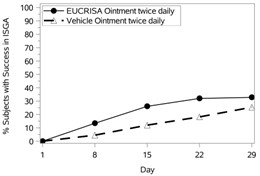
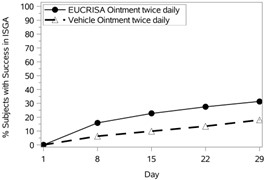
Success in ISGA* | 32.8% | 25.4% | 31.4% | 18.0% |
The success rates over time are presented in Figure 1.
| |
Figure 1: Success in ISGA* Over Time in Subjects with Mild to Moderate Atopic Dermatitis | |
Trial 1 | Trial 2 |
 |  |
One randomized, double-blind, vehicle-controlled trial (Trial 3) assessed the efficacy and safety of EUCRISA once daily over 52 weeks in pediatric (3 months to less than 18 years of age) and adult subjects with mild to moderate atopic dermatitis, who achieved success on EUCRISA twice daily during open-label treatment of up to 8 weeks.
A total of 497 subjects 3 months of age and older with a 2% to 90% treatable BSA, entered into an open-label period to receive EUCRISA twice daily for up to 8 weeks. At baseline, 327 (66%) of subjects were 3 months to less than 18 years of age, 66% of the subjects had an ISGA of moderate (3), and 34% had an ISGA of mild (2), in the overall assessment of atopic dermatitis (erythema, induration/papulation, and oozing/crusting) on a severity scale of 0 to 4.
Of the 497, a total of 254 subjects 3 months of age and older, who achieved both ISGA success (score of clear [0] or almost clear [1] with a ≥2 grade improvement from baseline) and EASI50 response (at least 50% improvement from baseline in EASI scores) were randomized 1:1 into a double-blind period to receive EUCRISA once daily or vehicle for 52 weeks or until they developed a flare. At the beginning of the double-blind period, 59% of the subjects had an ISGA of almost clear (1) and 41% had an ISGA of clear (0).
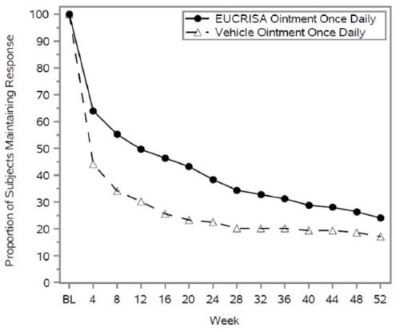
Figure 2 presents the percentage of subjects maintaining an ISGA of clear or almost clear through Week 52.
Figure 2: Percentage of Subjects Maintaining ISGA of Clear or Almost Clear Through Week 52
MEDICATION GUIDE
This Patient Information has been approved by the U.S. Food and Drug Administration. | Revised: 4/2023 | |
PATIENT INFORMATION | ||
Important information: EUCRISA is for use on skin (topical use) only. Do not use EUCRISA in your eyes, mouth, or vagina. | ||
What is EUCRISA? EUCRISA is a prescription medicine used on the skin (topical) to treat mild to moderate eczema (atopic dermatitis) in adults and children 3 months of age and older. It is not known if EUCRISA is safe and effective in children under 3 months of age. | ||
Who should not use EUCRISA? Do not use EUCRISA if you are allergic to crisaborole or any of the ingredients in EUCRISA. See the end of this Patient Information leaflet for a complete list of ingredients in EUCRISA. | ||
Before using EUCRISA, tell your healthcare provider about all of your medical conditions, including if you:
Tell your healthcare provider about all the medicines you take, including prescription and over-the-counter medicines, vitamins, and herbal supplements. | ||
How should I use EUCRISA?
| ||
What are the possible side effects of EUCRISA? EUCRISA may cause side effects.
| ||
| ||
| ||
| ||
The most common side effect of EUCRISA is application site pain, such as burning or stinging. This is not the only possible side effect of EUCRISA. Call your doctor for medical advice about side effects. You may report side effects to FDA at 1-800-FDA-1088. | ||
How should I store EUCRISA?
Keep EUCRISA and all medicines out of the reach of children. | ||
General information about the safe and effective use of EUCRISA Medicines are sometimes prescribed for purposes other than those listed in a Patient Information leaflet. Do not use EUCRISA for a condition for which it was not prescribed. Do not give EUCRISA to other people, even if they have the same symptoms that you have. It may harm them. You can ask your pharmacist or healthcare provider for information about EUCRISA that is written for healthcare professionals. | ||
What are the ingredients in EUCRISA? Active ingredient: crisaborole Inactive ingredients: white petrolatum, propylene glycol, mono- and di-glycerides, paraffin, butylated hydroxytoluene, and edetate calcium disodium.  LAB-0917-5.0 For more information, call 1-866-EUCRISA [1-866-382-7472] or go to www.EUCRISA.com | ||
Additional Resources
Chat online with Pfizer Medical Information regarding your inquiry on a Pfizer medicine or vaccine.
Speak with a Pfizer Medical Information Professional regarding your Pfizer medicine or vaccine inquiry.
Available 9AM-5PM ET Monday to Friday; excluding holidays.
Submit a medical question for a Pfizer medicine or a vaccine.
The submission will be reviewed during our standard business hours.
To report an adverse event related to a Pfizer product and you are not part of a clinical trial* for this medication, click the link below to submit your information:
Pfizer Safety Reporting Site
*If you are involved in a clinical trial for either product, adverse events should be reported to your coordinating study site.
If you cannot use the above website to report an adverse event related to a Pfizer medication, please call (800) 438-1985.
You may also contact the U.S. Food and Drug Administration (FDA) directly to report adverse events or product quality concerns either online at www.fda.gov/medwatch or by calling (800) 332-1088.