(medroxyprogesterone acetate)
12 CLINICAL PHARMACOLOGY
12 CLINICAL PHARMACOLOGY
12.1 Mechanism of Action
Depo-subQ provera 104 inhibits the secretion of gonadotropins, which primarily prevents follicular maturation and ovulation and causes thickening of cervical mucus. These actions contribute to its contraceptive effect.
Suppression of serum estradiol concentrations is likely to be responsible for the therapeutic effect on endometriosis-associated pain.
12.2 Pharmacodynamics
The following laboratory tests are expected to be affected by progestins including depo-subQ provera 104:
- •
- Plasma and urinary steroid levels are decreased (e.g., progesterone, estradiol, pregnanediol, testosterone, cortisol).
- •
- Gonadotropin levels are decreased.
- •
- Sex-hormone-binding-globulin concentrations are decreased.
- •
- Histology specimens may demonstrate changes consistent with progestin effects.
The following laboratory tests may be affected by depo-subQ provera 104, however the clinical significance is unknown:
- •
- Protein-bound iodine and butanol extractable protein-bound iodine may increase.
- •
- T3-uptake values may decrease.
- •
- Coagulation test values for prothrombin (Factor II), and Factors VII, VIII, IX, and X may increase.
- •
- Sulfobromophthalein and other liver function test values may be increased.
- •
- The effects of medroxyprogesterone acetate on lipid metabolism are inconsistent. Both increases and decreases in total cholesterol, triglycerides, low-density lipoprotein (LDL) cholesterol, and high-density lipoprotein (HDL) cholesterol have been observed in studies.
12.3 Pharmacokinetics
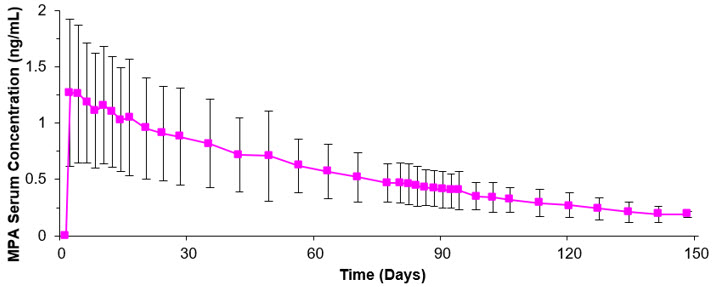
The pharmacokinetic parameters of MPA following a single subcutaneous injection of depo-subQ provera 104 in healthy women (n=42) are shown in Table 2 and Figure P.
| Cmax (ng/mL) | Tmax (day) | C91 (ng/mL) | AUC0–91 (ng∙day/mL) | AUC0–∞ (ng∙day/mL) | t½ (day) | |
|---|---|---|---|---|---|---|
| Abbreviations: Cmax=peak serum concentration; Tmax=time when Cmax is observed; C91=serum concentration at 91 days; AUC0–91 and AUC0–∞=area under the concentration-time curve over 91 days or infinity, respectively; t½=terminal half-life. | ||||||
Mean | 1.56 | 8.8 | 0.402 | 66.98 | 92.84 | 43 |
Min | 0.53 | 2.0 | 0.133 | 20.63 | 31.36 | 16 |
Max | 3.08 | 80.0 | 0.733 | 139.79 | 162.29 | 114 |
Following subcutaneous administration of single depo-subQ provera 104 doses ranging from 50 to 150 mg (0.48 and 1.4 times the recommended dose, respectively), the AUC and Cmin (Day 91) increased with higher doses, but there was considerable overlap across dose levels. Serum MPA concentrations at Day 91 increased in a dose proportional manner but Cmax did not appear to increase proportionally with increasing dose. The AUC data were suggestive of dose linearity.
Absorption
Following a single subcutaneous injection of depo-subQ provera 104 in healthy women, serum MPA concentrations reached ≥0.2 ng/mL within 24 hours. The mean Tmax was attained approximately 1 week after injection.
 |
In a study to assess accumulation and the achievement of steady state following multiple subcutaneous administrations, trough concentrations of MPA were determined after 6, 12, and 24 months, and in a subset of 8 subjects, bi-weekly concentrations were determined within one dosing interval in the second year of administration. The mean (SD) MPA trough concentrations were 0.67 (0.36) ng/mL (n=157), 0.79 (0.36) ng/mL (n=144), and 0.87 (0.33) ng/mL (n=106) at 6, 12, and 24 months, respectively.
Depo-subQ provera 104 was administered subcutaneously into the anterior thigh or the abdomen to evaluate effects of injection site location on the MPA concentration-time profile. MPA trough concentrations (Cmin; Day 91) were similar for the two injection site locations.
Distribution
Plasma protein binding of MPA averages 86%. MPA binding occurs primarily to serum albumin. No binding of MPA occurs with sex-hormone-binding globulin (SHBG).
Elimination
Metabolism
MPA is extensively metabolized in the liver by P450 enzymes. Its metabolism primarily involves ring A and/or side-chain reduction, loss of the acetyl group, hydroxylation in the 2-, 6-, and 21-positions or a combination of these positions, resulting in more than 10 metabolites.
Excretion
Residual MPA concentrations at the end of the first dosing interval (12 to 14 weeks) of depo-subQ provera 104 were generally below 0.5 ng/mL, consistent with its apparent terminal half-life of ~40 days after subcutaneous administration. Most MPA metabolites were excreted in the urine as glucuronide conjugates with only small amounts excreted as sulfates.
Specific Populations
Racial Groups
There were no significant differences in the pharmacokinetics and/or pharmacodynamics of MPA after subcutaneous administration of depo-subQ provera 104 in African-American, Caucasian, and Asian women.
Effect of Body Weight
Although total MPA exposure was lower in obese women, no dosage adjustment of depo-subQ provera 104 is necessary based on body weight. The effect of body weight on the pharmacokinetics of MPA following a single dose was assessed in a subset of women [n=42, body mass index (BMI) ranged from 18.2 to 46.7 kg/m2]. The AUC0–91 values for MPA were 71.6, 67.9, and 46.3 ng∙day/mL in women with BMI categories of ≤28 kg/m2, >28–38 kg/m2, and >38 kg/m2, respectively. The mean MPA Cmax was 1.74 ng/mL in women with BMI ≤28 kg/m2, 1.53 ng/mL in women with BMI >28–38 kg/m2, and 1.02 ng/mL in women with BMI >38 kg/m2, respectively. The MPA trough (Cmin) concentrations had a tendency to be lower in women with BMI >38 kg/m2.
MEDICATION GUIDE
PATIENT INFORMATION
DEPO-SUBQ PROVERA 104®
(deh-poh' sub-cue' pro-ver-ah' one-oh-four)
(medroxyprogesterone acetate injectable suspension)
for subcutaneous use
WHAT IS THE MOST IMPORTANT INFORMATION I SHOULD KNOW ABOUT depo-subQ provera 104?
Use of depo-subQ provera 104 may cause you to lose calcium stored in your bones. The longer you use depo-subQ provera 104 the more calcium you are likely to lose. The calcium may not return completely once you stop using depo-subQ provera 104.
Loss of calcium may cause weak, porous bones (osteoporosis) that could increase the risk that your bones might break, especially after menopause. It is not known whether your risk of developing osteoporosis may be greater if you are a teenager when you start to use depo-subQ provera 104.
You should use depo-subQ provera 104 long-term (for example, more than 2 years) only if other methods of birth control or other treatments for endometriosis pain are not right for you.
Depo-subQ provera 104 does not protect you from HIV (AIDS) and other sexually transmitted infections (STIs).
WHAT IS depo-subQ provera 104?
Depo-subQ provera 104 is a drug for birth control. It also helps relieve pain related to endometriosis (en-do-ME-tree-OH-sis). Symptoms of endometriosis arise when cells normally inside your uterus grow outside the uterus. The cells respond to menstrual cycle hormones, and may cause painful periods, pelvic pain, and painful sex.
Depo-subQ provera 104 contains a hormone called medroxyprogesterone acetate (MPA). It is given as a shot (injection) every 3 months. Three months is the same as 12 to 14 weeks.
HOW WELL DOES depo-subQ provera 104 WORK FOR PREVENTING PREGNANCY?
When you use depo-subQ provera 104 correctly, the chance of getting pregnant is very low. In studies, no women became pregnant during the year they used depo-subQ provera 104 injection.
The list below estimates the chances of getting pregnant using different types of birth control. The numbers are based on typical use. Typical use includes people who use the method correctly and people who use the method incorrectly. The list shows the number of women out of 100 women who will likely get pregnant if they use the method for 1 year.
| Method | Typical Chance of Getting Pregnant in 1 year (Number of pregnancies in 100 women) |
|---|---|
Shot | Less than 1 |
Pill | 5 |
Condom alone (male) | 14 |
Withdrawal | 19 |
Diaphragm with spermicides | 20 |
Condom alone (female) | 21 |
Periodic abstinence | 25 |
Spermicides alone | 26 |
Vaginal sponge or Cervical cap with spermicide | 20 to 40 |
HOW WILL I GET depo-subQ provera 104?
Depo-subQ provera 104 is given as a shot just under the skin on your thigh or belly. You get it once every 3 months.
For Birth Control
First shot:
Your healthcare professional will want to be sure that you are not pregnant before you get your first shot. Normally, you get the shot by the 5th day from the START of your menstrual period. You get it whether or not you are still bleeding.
If you are breast-feeding, you may have your first shot as early as 6 weeks after you deliver your baby.
After the first shot:
It is very important to keep getting depo-subQ provera 104 every 3 months. If you wait more than 14 weeks between shots, you could become pregnant. Your healthcare professional must make sure you are not pregnant before you get your next shot.
When you get your shot, make an appointment for your next shot. Mark it on your calendar.
If you need a birth control method for more than two years, your healthcare professional may ask you to have a test of your bones or ask you to switch to another birth control method before continuing depo-subQ provera 104, especially if you have other risks for weak bones.
For Endometriosis
If you have regular periods, you will get depo-subQ provera 104 the same way as described above for birth control. If your periods have stopped or are not regular, your healthcare professional must test to make sure you are not pregnant before you get your first shot.
It is not recommended that you receive depo-subQ provera 104 for treatment of endometriosis for longer than 2 years. If your painful symptoms return after stopping treatment, your healthcare professional should ask you to have a test of your bones before restarting treatment.
WHAT IF I MISS A SHOT?
If you miss a shot, or wait longer than 14 weeks between shots, you could get pregnant. The longer you wait, the greater the risk of getting pregnant.
Talk with your healthcare professional to find out when to restart depo-subQ provera 104. You should be tested to be sure you are not pregnant.
Use another kind of non-hormonal birth control, such as condoms, until you start depo-subQ provera 104 again.
DO NOT TAKE depo-subQ provera 104 IF YOU…
- •
- Have any unexplained vaginal bleeding
- •
- Have or have ever had breast cancer or think you have breast cancer
- •
- Ever had serious blood clots, such as blood clots in your legs (deep venous thrombophlebitis), lungs (pulmonary embolism), heart (heart attack), or head (stroke)
- •
- Have liver disease
- •
- Are allergic to anything in depo-subQ provera 104. There is a list of what is in depo-subQ provera 104 at the end of this leaflet.
BEFORE TAKING depo-subQ provera 104
Your healthcare professional may do a physical examination and check your blood and urine.
Tell your healthcare professional about all your medical conditions.
Most importantly, tell your healthcare professional if you:
- •
- Are pregnant or might be pregnant. You should not get depo-subQ provera 104 if you are pregnant.
- •
- Plan to become pregnant in the next year. After you stop getting depo-subQ provera 104, it takes time for your body to be able to get pregnant. It can be as early as 1 week after the last shot wears off. Most likely it will take up to 1 year or longer for you to get pregnant.
- •
- Have or have ever had breast cancer, or think you have breast cancer
- •
- Have breast cancer in your family
- •
- Have an abnormal mammogram (breast X-ray), lumps in your breast, or bleeding from your nipples
- •
- Have or have ever had a type of usually benign brain tumor called a meningioma
- •
- Have irregular, light, or heavy menstrual periods
- •
- Have or had any of the following medical problems:
- o
- Kidney problems
- o
- High blood pressure
- o
- Migraine headaches
- o
- Asthma
- o
- Seizures
- o
- Diabetes, or if it runs in your family
- o
- Depression
- o
- Heart attack, stroke, or blood clots
- o
- Bone disease
- o
- Anorexia nervosa (an eating disorder)
- o
- A strong family history of osteoporosis
- o
- Use of a drug that can lower the amount of calcium in bones (drugs for epilepsy or steroids)
- o
- Drinking a lot of alcohol or smoking a lot
It is important to see your healthcare professional regularly if you have any of these conditions.
Some medicines may make depo-subQ provera 104 less effective at preventing pregnancy, including those listed below:
- •
- Bosentan (used to treat pulmonary arterial hypertension)
- •
- Efavirenz, etravirine (HIV medicines)
- •
- Modafinil (used to improve wakefulness)
- •
- Mitotane (used to treat adrenal cortical carcinoma)
- •
- Phenytoin, carbamazepine, phenobarbital (used to treat seizures)
- •
- Rifampin (an antibiotic)
- •
- St. John's Wort (herbal medicinal product)
Tell your healthcare professional about all the medicines you take. This includes prescription and over-the-counter medicines, vitamins, and herbal products.
WHAT ELSE SHOULD I KNOW ABOUT TAKING depo-subQ provera 104?
Other Birth Control. If you can't take birth control pills or can't use a birth control patch or ring, you may be able to use depo-subQ provera 104. Ask your healthcare professional.
Pregnancy. When you take depo-subQ provera 104 every 3 months, your chance of getting pregnant is very low. You could miss a period or have a light period and not be pregnant. If you miss 1 or 2 periods and think you might be pregnant, see your healthcare professional as soon as possible.
You should not use depo-subQ provera 104 if you are pregnant. However, depo-subQ provera 104 taken by accident during pregnancy does not seem to cause birth defects.
Pregnancy in your fallopian tubes (Ectopic Pregnancy). If you have severe pain low in your belly, tell your healthcare professional right away. Infrequently, a baby may start to grow outside the uterus, most often in the tubes.
Nursing a baby. Wait at least 6 weeks after your baby is born to start depo-subQ provera 104. You can use depo-subQ provera 104 if you are nursing.
It does not lower the amount of milk you can make.
It can pass through breast milk into your baby, but it is not harmful.
Blood or urine tests. Depo-subQ provera 104 may affect blood or urine test results. Tell your healthcare professional you are taking depo-subQ provera 104 if you are going to have blood or urine tests.
Liver problems. Your healthcare professional may stop depo-subQ provera 104 if you have liver problems. Some signs of liver problems are yellow skin or eyes, feeling like you have the flu, feeling more tired than usual, and itching. Tell your healthcare professional if you have these symptoms.
WHAT ARE THE MOST SERIOUS RISKS OF depo-subQ provera 104?
Losing calcium from your bones. Depo-subQ provera 104 use may decrease the amount of calcium in your bones. The longer you use depo-subQ provera 104, the more calcium you are likely to lose. This increases the risk of your bones weakening if you use depo-subQ provera 104 continuously for a long time (for example, if you use depo-subQ provera 104 for more than 2 years). The loss of calcium may increase your risk of osteoporosis and broken bones, particularly after your menopause.
Calcium is generally added to the bones during teenage years. The decrease of calcium in your bones is of most concern if you are a teenager or have the following risk factors:
- •
- Bone disease
- •
- Anorexia nervosa (an eating disorder)
- •
- A strong family history of osteoporosis
- •
- Using a drug that can lower the amount of calcium in bones (drugs for epilepsy or steroids), or
- •
- Drinking a lot of alcohol or smoking a lot
If you need a birth control method for more than 2 years, your healthcare professional may ask you to have a test of your bones or ask you to switch to another birth control method before continuing depo-subQ provera 104, especially if you have other risks for weak bones. When depo-subQ provera 104 is stopped, the calcium in your bones begins to come back. The lost calcium may not return completely once you stop using depo-subQ provera 104.
Abnormal or very heavy bleeding. If you start having very heavy or very long periods, tell your healthcare professional.
Allergic reaction. Allergic reactions to depo-subQ provera 104 have been reported. If you have hives, problems breathing, swelling of the face, mouth, tongue, or neck, or just do not feel right after your shot, call your healthcare professional or go to the Emergency Room right away.
Serious blood clots. Call your healthcare professional immediately if you:
- •
- Have sharp chest pain, cough blood, or suddenly have trouble breathing
- •
- Have a sudden severe headache with vomiting, blindness or trouble talking, weakness, or numbness in an arm or leg, or get dizzy or faint
- •
- Have swelling or severe pain in your leg
Depression. If you suffer from depression or have a history of depression, inform your healthcare professional if you notice any worsening of your depression while taking depo-subQ provera 104.
Meningioma (a type of usually benign brain tumor). Possible increased risk for growth of a meningioma, primarily when the product is used for a long time.
WHAT ARE COMMON SIDE EFFECTS OF depo-subQ provera 104?
The most common side effects are:
- •
- Changes in your monthly periods. You may not know when you will bleed, your periods may not be regular, you may have heavy bleeding, or you may have spotting. You may have more days of bleeding during the first 2 or 3 months after you start depo-subQ provera 104. Over time, you may have less and less bleeding. Many women stop having periods by the end of 1 year. Your periods will come back eventually after you stop using depo-subQ provera 104.
- •
- Headache.
- •
- Weight gain. In studies, women gained an average of 3 to 4 pounds during the first year they used depo-subQ provera 104. After 2 years of using depo-subQ provera 104, women gained an average of 7 to 8 pounds. Some women gained more, some gained less, some lost, and some stayed the same. Weight changes beyond 2 years of use with depo-subQ provera 104 have not been studied. Women who used a similar birth control product for 5 years gained on average 5 pounds more than women who did not use a hormone contraceptive product.
- •
- Skin reaction where you got the shot. Lumps, skin dimpling, or pain may occur. Scarring and discoloration are uncommon, but may happen. If there is swelling or your skin gets hot, has pus or looks bruised 1 or more days after your shot, call your healthcare professional.
Women using depo-subQ provera 104 for birth control or endometriosis had these less common side effects: Vaginal inflammation, vaginal thrush, abdominal pain, urinary tract infections, acne, depression, less sex drive, nausea, back pain, breast pain/tenderness, fatigue, anxiety, being irritable, dizziness, hot flushes and fluid retention.
If you feel you are having other side effects, talk with your healthcare professional.
DOES depo-subQ provera 104 CAUSE CANCER?
There have been several studies of women who use birth control like depo-subQ provera 104.
- •
- Women who use depo-subQ provera 104 may have a slightly increased risk of breast cancer compared to non-users.
- •
- The risk of cancer of the ovary, liver, or cervix did not change.
WHAT IF I WANT TO BECOME PREGNANT?
Plan ahead. The effect of depo-subQ provera 104 can last for a long time after you stop getting shots. Although you may be able to get pregnant quickly, it is more likely to take a year or longer after your last shot before you get pregnant.
It's best to see your healthcare professional for a pre-pregnancy check-up. Your healthcare professional may also tell you to take a vitamin called folic acid every day if you are planning to become pregnant.
GENERAL ADVICE ABOUT depo-subQ provera 104
For more information about depo-subQ provera 104, ask your healthcare professional or pharmacist.
WHAT IS IN depo-subQ provera 104?
Active ingredient: medroxyprogesterone acetate.
Inactive ingredients: methylparaben, propylparaben, sodium chloride, polyethylene glycol, polysorbate 80, monobasic sodium phosphate∙H2O, dibasic sodium phosphate∙12H2O, methionine, povidone, water for shot. When necessary, the pH is adjusted with sodium hydroxide or hydrochloric acid, or both.
This product's labeling may have been updated. For the most recent prescribing information, please visit www.pfizer.com.

LAB-0298-12.0
Revised December 2025
Additional Resources
Chat online with Pfizer Medical Information regarding your inquiry on a Pfizer medicine or vaccine.
Speak with a Pfizer Medical Information Professional regarding your Pfizer medicine or vaccine inquiry.
Available 9AM-5PM ET Monday to Friday; excluding holidays.
Submit a medical question for a Pfizer medicine or a vaccine.
The submission will be reviewed during our standard business hours.
To report an adverse event related to a Pfizer product and you are not part of a clinical trial* for this medication, click the link below to submit your information:
Pfizer Safety Reporting Site
*If you are involved in a clinical trial for either product, adverse events should be reported to your coordinating study site.
If you cannot use the above website to report an adverse event related to a Pfizer medication, please call (800) 438-1985.
You may also contact the U.S. Food and Drug Administration (FDA) directly to report adverse events or product quality concerns either online at www.fda.gov/medwatch or by calling (800) 332-1088.