(medroxyprogesterone acetate injectable suspension, for intramuscular use)
14 CLINICAL STUDIES
14 CLINICAL STUDIES
14.1 Contraception
In five clinical studies using Depo-Provera CI, the 12-month failure rate for the group of women treated with Depo-Provera CI was zero (no pregnancies reported) to 0.7 by Life-Table method. The effectiveness of Depo‑Provera CI is dependent on the patient returning every 3 months (13 weeks) for reinjection.
14.2 Bone Mineral Density Changes in Women Treated with Depo-Provera CI
In a controlled, clinical study, adult women using Depo-Provera CI (150mg) for up to 5 years showed spine and hip bone mineral density (BMD) mean decreases of 5–6%, compared to no significant change in BMD in the control group. The decline in BMD was more pronounced during the first two years of use, with smaller declines in subsequent years. Mean changes in lumbar spine BMD of ‑2.86%, ‑4.11%, ‑4.89%, ‑4.93% and ‑5.38% after 1, 2, 3, 4, and 5 years, respectively, were observed. Mean decreases in BMD of the total hip and femoral neck were similar.
After stopping use of Depo-Provera CI, there was partial recovery of BMD toward baseline values during the 2-year post-therapy period. Longer duration of treatment was associated with less complete recovery during this 2-year period following the last injection. Table 4 shows the change in BMD in women after 5 years of treatment with Depo-Provera CI and in women in a control group, as well as the extent of recovery of BMD for the subset of the women for whom 2-year post treatment data were available.
| Time in Study | Spine | Total Hip | Femoral Neck | |||
|---|---|---|---|---|---|---|
| Depo-Provera* | Control† | Depo-Provera* | Control† | Depo-Provera* | Control† | |
5 years | -5.38% | 0.43% | -5.16% | 0.19% | -6.12% | -0.27% |
7 years | -3.13% | 0.53% | -1.34% | 0.94% | -5.38% | -0.11% |
14.3 Bone Mineral Density Changes in Adolescent Females (12 to 18 Years of Age) Treated with Depo-Provera CI
The impact of Depo-Provera CI (150 mg) use for up to 240 weeks (4.6 years) was evaluated in an open-label non-randomized clinical study in 389 adolescent females (12 to 18 years of age). Use of Depo-Provera CI was associated with a significant decline from baseline in BMD.
Partway through the trial, drug administration was stopped (at 120 weeks). The mean number of injections per Depo-Provera CI user was 9.3. Table 5 summarizes the study findings. The decline in BMD at total hip and femoral neck was greater with longer duration of use. The mean decrease in BMD at 240 weeks was more pronounced at total hip (-6.4%) and femoral neck (-5.4%) compared to lumbar spine (-2.1%).
Adolescents in the untreated cohort had an increase in BMD during the period of growth following menarche. However, the two cohorts were not matched at baseline for age, gynecologic age, race, BMD and other factors that influence the rate of acquisition of BMD.
| Duration of Treatment | Depo-Provera CI (150 mg IM) | Unmatched, Untreated Cohort | ||
|---|---|---|---|---|
| N | Mean % Change | N | Mean % Change | |
Total Hip BMD | ||||
Week 60 (1.2 years) | 113 | -2.75 | 166 | 1.22 |
Week 120 (2.3 years) | 73 | -5.40 | 109 | 2.19 |
Week 240 (4.6 years) | 28 | -6.40 | 84 | 1.71 |
Femoral Neck BMD | ||||
Week 60 | 113 | -2.96 | 166 | 1.75 |
Week 120 | 73 | -5.30 | 108 | 2.83 |
Week 240 | 28 | -5.40 | 84 | 1.94 |
Lumbar Spine BMD | ||||
Week 60 | 114 | -2.47 | 167 | 3.39 |
Week 120 | 73 | -2.74 | 109 | 5.28 |
Week 240 | 27 | -2.11 | 84 | 6.40 |
BMD Recovery Post-Treatment in Adolescents
Longer duration of treatment and smoking were associated with less recovery of BMD following the last injection of Depo-Provera CI. Table 6 shows the extent of recovery of BMD up to 60 months post-treatment for adolescents who received Depo-Provera CI for two years or less compared to more than two years. Post‑treatment follow-up showed that, in women treated for more than two years, only lumbar spine BMD recovered to baseline levels after treatment was discontinued. Adolescents treated with Depo-Provera CI for more than two years did not recover to their baseline BMD level at femoral neck and total hip even up to 60 months post-treatment. Adolescents in the untreated cohort gained BMD throughout the trial period (data not shown) [see Warnings and Precautions (5.1)].
| Duration of Treatment | 2 years or less | More than 2 years | ||
|---|---|---|---|---|
| N | Mean % Change from baseline | N | Mean % Change from baseline | |
Total Hip BMD | ||||
End of Treatment | 49 | -1.5% | 49 | -6.2% |
12 M post-treatment | 33 | -1.4% | 24 | -4.6% |
24 M post-treatment | 18 | 0.3% | 17 | -3.6% |
36 M post-treatment | 12 | 2.1% | 11 | -4.6% |
48 M post-treatment | 10 | 1.3% | 9 | -2.5% |
60 M post-treatment | 3 | 0.2% | 2 | -1.0% |
Femoral Neck BMD | ||||
End of Treatment | 49 | -1.6% | 49 | -5.8% |
12 M post-treatment | 33 | -1.4% | 24 | -4.3% |
24 M post-treatment | 18 | 0.5% | 17 | -3.8% |
36 M post-treatment | 12 | 1.2% | 11 | -3.8% |
48 M post-treatment | 10 | 2.0% | 9 | -1.7% |
60 M post-treatment | 3 | 1.0% | 2 | -1.9% |
Lumbar Spine BMD | ||||
End of Treatment | 49 | -0.9% | 49 | -3.5% |
12 M post-treatment | 33 | 0.4% | 23 | -1.1% |
24 M post-treatment | 18 | 2.6% | 17 | 1.9% |
36 M post-treatment | 12 | 2.4% | 11 | 0.6% |
48 M post-treatment | 10 | 6.5% | 9 | 3.5% |
60 M post-treatment | 3 | 6.2% | 2 | 5.7% |
14.4 Bone Fracture Incidence in Women Treated with Depo-Provera CI
A retrospective cohort study to assess the association between Depo-Provera CI injection and the incidence of bone fractures was conducted in 312,395 female contraceptive users in the UK. The incidence rates of fracture were compared between Depo-Provera CI users and contraceptive users who had no recorded use of Depo-Provera CI. The Incident Rate Ratio (IRR) for any fracture during the follow-up period (mean=5.5 years) was 1.41 (95% CI 1.35, 1.47). It is not known if this is due to Depo-Provera CI use or to other related lifestyle factors that have a bearing on fracture rate.
In the study, when cumulative exposure to Depo-Provera CI was calculated, the fracture rate in users who received fewer than 8 injections was higher than that in women who received 8 or more injections. However, it is not clear that cumulative exposure, which may include periods of intermittent use separated by periods of non-use, is a useful measure of risk, as compared to exposure measures based on continuous use.
There were very few osteoporotic fractures (fracture sites known to be related to low BMD) in the study overall, and the incidence of osteoporotic fractures was not found to be higher in Depo-Provera CI users compared to non-users.
Importantly, this study could not determine whether use of Depo-Provera CI has an effect on fracture rate later in life.
PATIENT INFORMATION
Patient Information
Depo-Provera® (DEP-po pro-VAIR-ah) CI
(medroxyprogesterone acetate injectable suspension)
Contraceptive Injection
Read this Patient Information carefully before you decide if Depo-Provera CI is right for you. This information does not take the place of talking with your gynecologist or other healthcare professional who specializes in women's health. If you have any questions about Depo-Provera CI, ask your healthcare professional. You should also learn about other birth control methods to choose the one that is best for you.
What is the most important information I should know about Depo-Provera CI?
Depo-Provera CI can cause serious side effects, including:
- •
- Use of Depo-Provera CI may cause you to lose calcium stored in your bone and decrease your bone mass. The longer you use Depo-Provera CI, the greater your loss of calcium from your bones. Your bones may not recover completely when you stop using Depo-Provera CI.
- •
- If you use Depo-Provera CI continuously for a long time (for more than 2 years), it may increase the risk of weak, porous bones (osteoporosis) that could increase the risk of broken bones, especially after menopause.
- •
- You should not use Depo-Provera CI for more than two years unless you cannot use other birth control methods.
- •
- It is not known if your risk of developing osteoporosis is greater if you are a teenager or young adult when you start to use Depo-Provera CI (see "What are the possible side effects of Depo-Provera CI?").
Depo-Provera CI is intended to prevent pregnancy. Depo-Provera CI does not protect against HIV infection (AIDS) and other sexually transmitted infections (STIs).
What is Depo-Provera CI?
Depo-Provera CI is a progestin hormone birth control method that is given by injection (a shot) to prevent pregnancy.
How well does Depo-Provera CI work?
Your chance of getting pregnant depends on how well you follow the directions for taking your Depo-Provera CI. The more carefully you follow the directions (such as returning every 3 months for your next injection), the less chance you have of getting pregnant.
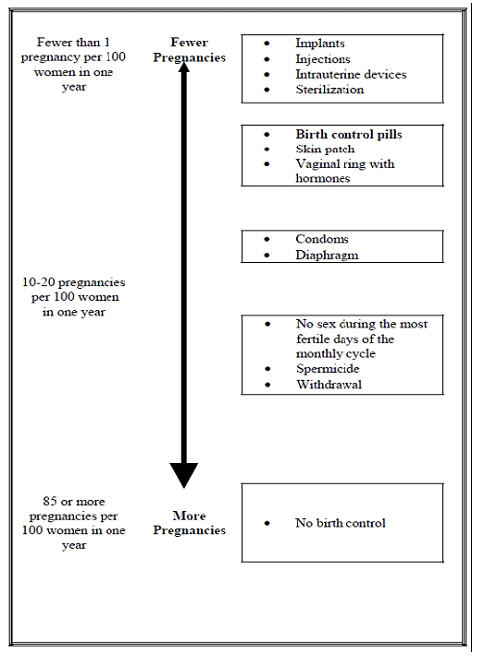
In clinical studies, about 1 out of 100 women got pregnant during the first year that they used Depo-Provera CI.
The following chart shows the chance of getting pregnant for women who use different methods of birth control. Each box on the chart contains a list of birth control methods that are similar in effectiveness. The most effective methods are at the top of the chart. The box on the bottom of the chart shows the chance of getting pregnant for women who do not use birth control and are trying to get pregnant.
How should I take Depo-Provera CI?
- •
- Depo-Provera CI is given by your healthcare professional as a shot into your muscle (intramuscular injection). The shot is given in your buttock or upper arm 1 time every 3 months. At the end of the 3 months, you will need to return to your healthcare professional for your next injection in order to continue your protection against pregnancy.
- •
- To make sure that you are not pregnant before you take Depo-Provera CI, the first injection should be given only:
- o
- during the first 5 days of a normal menstrual period, or
- o
- within the first 5 days after giving birth, if you are not breastfeeding, or
- o
- at the 6th week after giving birth, if you are feeding your baby only breastmilk.
- •
- Depo-Provera CI may be given at other times than those listed above, but you will likely need to have a pregnancy test first to show that you are not pregnant.
- •
- During treatment with Depo-Provera CI, you should see your healthcare professional every year for a blood pressure check and other healthcare needs.
Who Should Not Use Depo-Provera CI?
Do not use Depo-Provera CI if you:
- •
- have bleeding from your vagina that has not been explained
- •
- have breast cancer now or in the past, or think you have breast cancer
- •
- have had a stroke
- •
- ever had blood clots in your arms, legs or lungs
- •
- have problems with your liver or liver disease
- •
- are allergic to medroxyprogesterone acetate or any of the other ingredients in Depo-Provera CI. See the end of this leaflet for a complete list of ingredients in Depo-Provera CI.
What should I tell my healthcare professional before taking Depo-Provera CI?
Before taking Depo-Provera CI, tell your healthcare professional if you have:
- •
- risk factors for weak bones (osteoporosis) such as bone disease, use alcohol or smoke regularly, anorexia nervosa, or a strong family history of osteoporosis
- •
- irregular or lighter than usual menstrual periods
- •
- breast cancer now or in the past, or think you have breast cancer
- •
- a family history of breast cancer
- •
- an abnormal mammogram (breast X-ray), lumps in your breasts, or bleeding from your nipples
- •
- have or have ever had a type of usually benign brain tumor called a meningioma
- •
- kidney problems
- •
- high blood pressure
- •
- had a stroke
- •
- had blood clots in your arms, legs or lungs
- •
- migraine headaches
- •
- asthma
- •
- epilepsy (convulsions or seizures)
- •
- diabetes
- •
- depression or a history of depression
- •
- any other medical conditions
If you are breastfeeding or plan to breastfeed, Depo-Provera CI can pass into your breast milk. Talk to your healthcare professional about the best way to feed your baby if you take Depo-Provera CI.
Tell your healthcare professional about all of the medicines you take, including prescription and nonprescription medicines, vitamins, and herbal supplements.
Depo-Provera CI and certain other medicines may affect each other, causing serious side effects. Sometimes the doses of other medicines may need to be changed while you are taking Depo-Provera CI.
Some medicines may make Depo-Provera CI less effective at preventing pregnancy, including those listed below.
Especially tell your healthcare professional if you take:
- •
- medicine to help you sleep
- •
- bosentan
- •
- medicine for seizures
- •
- griseofulvin
- •
- an antibiotic
- •
- medicine for HIV (AIDS)
- •
- St. John's wort
Know the medicines you take. Keep a list of your medicines with you to show your healthcare professional or pharmacist before you first start taking Depo-Provera CI or when you get a new medicine.
Follow your healthcare professional's instructions about using a back-up method of birth control if you are taking medicines that may make Depo-Provera CI less effective.
What are the possible side effects of Depo-Provera CI?
Depo-Provera CI can cause serious side effects, including:
- •
- Effect on the bones: See "What is the most important information I should know about Depo-Provera CI?".
Teenage years are the most important years to gain bone strength. The decrease in calcium in your bones is of most concern if you are a teenager or have the following problems:- •
- bone disease
- •
- an eating disorder (anorexia nervosa)
- •
- a strong family history of osteoporosis
- •
- you take a drug that can lower the amount of calcium in your bones (drugs for epilepsy or steroid drugs)
- •
- you drink a lot of alcohol (more than 2 drinks a day)
- •
- you smoke
- If you need a birth control method for more than 2 years, your healthcare professional may switch you to another birth control method instead of using Depo-Provera CI. If you continue using Depo-Provera CI, your healthcare professional may ask you to have a bone test, especially if you have other risks for weak bones.
- When Depo-Provera CI is stopped, your bones may start to regain calcium. However, in a study of teenage girls who used Depo-Provera CI for more than 2 years, their hip bones did not completely recover by 5 years after they stopped using Depo-Provera CI. Taking calcium and Vitamin D and exercising daily may lessen the loss of calcium from your bones.
- •
- possible increased risk of breast cancer. Women who use Depo-Provera CI may have a slightly increased risk of breast cancer compared to non-users.
- •
- blood clots in your arms, legs, lungs, and eyes
- •
- stroke
- •
- a pregnancy outside of your uterus (ectopic pregnancy). Ectopic pregnancy is a medical emergency that often requires surgery. Ectopic pregnancy can cause internal bleeding, infertility, and even death.
- •
- allergic reactions. Severe allergic reactions have been reported in some women using Depo-Provera CI.
- •
- loss of vision or other eye problems
- •
- migraine headaches
- •
- possible increased risk for growth of a meningioma (a usually benign brain tumor), primarily when the product is used for a long time.
- •
- depression
- •
- convulsions or seizures
- •
- liver problems
Call your healthcare professional right away if you have:
- •
- sharp chest pain, coughing up blood, or sudden shortness of breath (indicating a possible clot in the lung)
- •
- sudden severe headache or vomiting, dizziness or fainting, problems with your eyesight or speech, weakness, or numbness in an arm or leg (indicating a possible stroke)
- •
- severe pain or swelling in the calf (indicating a possible clot in the leg)
- •
- sudden blindness, partial or complete (indicating a possible clot in the blood vessels of the eye)
- •
- unusually heavy vaginal bleeding
- •
- severe pain or tenderness in the lower abdominal area
- •
- persistent pain, pus, or bleeding at the injection site
- •
- yellowing of the eyes or skin
- •
- hives
- •
- difficulty breathing
- •
- swelling of the face, mouth, tongue or neck
The most common side effects of Depo-Provera CI include:
- •
- irregular vaginal bleeding, such as lighter or heavier menstrual bleeding, or continued spotting
- •
- weight gain. You may experience weight gain while you are using Depo-Provera CI. About two-thirds of the women who used Depo-Provera CI in the clinical trials reported a weight gain of about 5 pounds during the first year of use. You may continue to gain weight after the first year. Women who used Depo-Provera CI for 2 years gained an average of 8 pounds over those 2 years.
- •
- abdominal pain
- •
- headache
- •
- weakness
- •
- tiredness
- •
- nervousness
- •
- dizziness
Tell your healthcare professional if you have any side effect that bothers you or does not go away.
These are not all the possible side effects of Depo-Provera CI. For more information, ask your healthcare professional or pharmacist.
Call your doctor for medical advice about side effects. You may report side effects to FDA at 1- 800-FDA-1088.
What other information should I know before choosing Depo-Provera CI?
- •
- Pregnancy. When you take Depo-Provera CI every 3 months, your chance of getting pregnant is very low. You could miss a period or have a light period and not be pregnant. If you miss 1 or 2 periods and think you might be pregnant, see your healthcare professional as soon as possible. You should not use Depo-Provera CI if you are pregnant. However, Depo-Provera CI taken by accident during pregnancy does not seem to cause birth defects.
- •
- Nursing Mothers. Although Depo-Provera CI can be passed to the nursing baby in the breast milk, no harmful effects on babies have been found. Depo-Provera CI does not stop the breasts from producing milk, so it can be used by nursing mothers. However, to minimize the amount of Depo-Provera CI that is passed to the baby in the first weeks after birth, you should wait until your baby is 6 weeks old before you start using Depo-Provera CI for birth control.
How will Depo-Provera CI change my periods?
- •
- Change in normal menstrual cycle. The side effect reported most frequently by women who use Depo-Provera CI for birth controls is a change in their normal menstrual cycle. During the first year of using Depo-Provera CI, you might have one or more of the following changes:
- o
- irregular or unpredictable bleeding or spotting
- o
- an increase or decrease in menstrual bleeding
- o
- no bleeding at all. In clinical studies of Depo-Provera CI, 55% of women reported no menstrual bleeding (amenorrhea) after one year of use and 68% of women reported no menstrual bleeding after two years of use.
- •
- Missed period. During the time you are using Depo-Provera CI for birth controls, you may skip a period, or your periods may stop completely. If you have been receiving your shot of Depo-Provera CI regularly every 3 months, then you are probably not pregnant. However, if you think that you may be pregnant, see your healthcare professional.
Unusually heavy or continuous bleeding is not a usual effect of Depo-Provera CI and if this happens you should see your healthcare professional right away.
With continued use of Depo-Provera CI, bleeding usually decreases and many women stop having periods completely. When you stop using Depo-Provera CI your menstrual period will usually, in time, return to its normal cycle.
What if I want to become pregnant?
Because Depo-Provera CI is a long-acting birth control method, it takes some time after your last shot for its effect to wear off. Most women who try to get pregnant after using Depo-Provera CI get pregnant within 18 months after their last shot. The length of time you use Depo-Provera CI has no effect on how long it takes you to become pregnant after you stop using it.
General Information about Depo-Provera CI
Medicines are sometimes prescribed for conditions that are not mentioned in patient information leaflets. This leaflet summarizes the most important information about Depo-Provera CI. If you would like more information, talk with your healthcare professional. You can ask your healthcare professional for information about Depo-Provera CI that is written for healthcare professionals.
What are the ingredients in Depo-Provera CI?
Active ingredient: medroxyprogesterone acetate
Inactive ingredients: polyethylene glycol 3350, polysorbate 80, sodium chloride, methylparaben, propylparaben, and water for injection. When necessary, pH is adjusted with sodium hydroxide or hydrochloric acid, or both.
This Patient Information has been approved by the U.S. Food and Drug Administration.
This product's labeling may have been updated. For the most recent prescribing information, please visit www.pfizer.com.

LAB-0148-15.0
Revised December 2025
Additional Resources
Chat online with Pfizer Medical Information regarding your inquiry on a Pfizer medicine or vaccine.
Speak with a Pfizer Medical Information Professional regarding your Pfizer medicine or vaccine inquiry.
Available 9AM-5PM ET Monday to Friday; excluding holidays.
Submit a medical question for a Pfizer medicine or a vaccine.
The submission will be reviewed during our standard business hours.
To report an adverse event related to a Pfizer product and you are not part of a clinical trial* for this medication, click the link below to submit your information:
Pfizer Safety Reporting Site
*If you are involved in a clinical trial for either product, adverse events should be reported to your coordinating study site.
If you cannot use the above website to report an adverse event related to a Pfizer medication, please call (800) 438-1985.
You may also contact the U.S. Food and Drug Administration (FDA) directly to report adverse events or product quality concerns either online at www.fda.gov/medwatch or by calling (800) 332-1088.