(encorafenib)
14 CLINICAL STUDIES
14 CLINICAL STUDIES
14.1 BRAF V600E or V600K Mutation-Positive Unresectable or Metastatic Melanoma
BRAFTOVI in combination with binimetinib was evaluated in a randomized, active-controlled, open-label, multicenter trial (COLUMBUS; NCT01909453). Eligible patients were required to have BRAF V600E or V600K mutation-positive unresectable or metastatic melanoma, as detected using the bioMerieux THxID™ BRAF assay. Patients were permitted to have received immunotherapy in the adjuvant setting and one prior line of immunotherapy for unresectable locally advanced or metastatic disease. Prior use of BRAF inhibitors or MEK inhibitors was prohibited. Randomization was stratified by American Joint Committee on Cancer (AJCC) Stage (IIIB, IIIC, IVM1a or IVM1b, versus IVM1c), Eastern Cooperative Oncology Group (ECOG) performance status (0 versus 1), and prior immunotherapy for unresectable or metastatic disease (yes versus no).
Patients were randomized (1:1:1) to receive BRAFTOVI 450 mg once daily in combination with binimetinib 45 mg twice daily (BRAFTOVI in combination with binimetinib), BRAFTOVI 300 mg once daily, or vemurafenib 960 mg twice daily. Treatment continued until disease progression or unacceptable toxicity. Only the results of the approved dosing (BRAFTOVI 450 mg in combination with binimetinib 45 mg) are described below.
The major efficacy outcome measure was progression-free survival (PFS), as assessed by a blinded independent central review, to compare BRAFTOVI in combination with binimetinib with vemurafenib. Additional efficacy outcome measures included overall survival (OS), as well as objective response rate (ORR) and duration of response (DoR) which were assessed by central review.
A total of 577 patients were randomized, 192 to the BRAFTOVI in combination with binimetinib arm, 194 to the BRAFTOVI arm, and 191 to the vemurafenib arm. Of the 383 patients randomized to either the BRAFTOVI in combination with binimetinib or the vemurafenib arms, the median age was 56 years (20 to 89 years), 59% were male, 91% were White, and 72% had baseline ECOG performance status of 0. Ninety-five percent (95%) had metastatic disease, 65% were Stage IVM1c, and 4% received prior CTLA-4, PD-1, or PD-L1 directed antibodies. Twenty-eight percent (28%) had elevated baseline serum lactate dehydrogenase (LDH), 45% had ≥3 organs with tumor involvement at baseline, and 3% had brain metastases. Based on centralized testing, 100% of patients' tumors tested positive for BRAF mutations; BRAF V600E (88%), BRAF V600K (11%), or both (<1%).
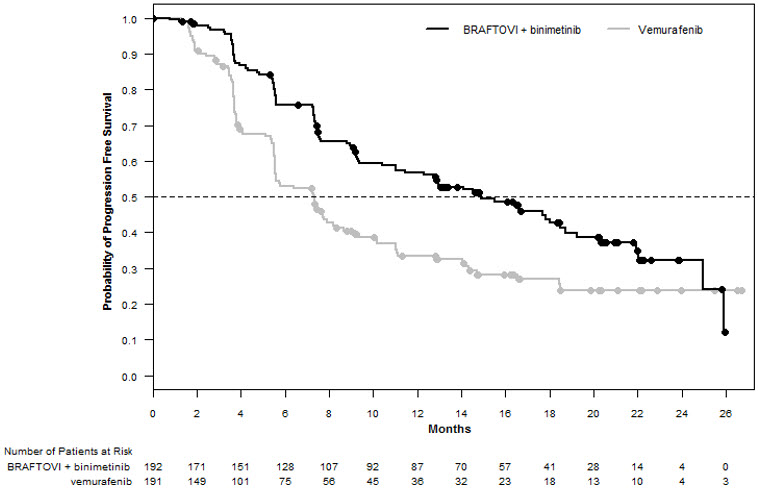
BRAFTOVI in combination with binimetinib demonstrated a statistically significant improvement in PFS compared to vemurafenib. Efficacy results are summarized in Table 15 and Figure 1.
| CI = Confidence interval; CR = Complete response; DoR = Duration of response; HR = Hazard ratio; NE = Not estimable; ORR = Overall response rate; OS = Overall survival; PFS = Progression-free survival; PR = Partial response. | ||
| ||
BRAFTOVI | Vemurafenib | |
Progression-Free Survival | ||
Number of events (%) | 98 (51) | 106 (55) |
Progressive disease | 88 (46) | 104 (54) |
Death | 10 (5) | 2 (1) |
Median PFS, months (95% CI) | 14.9 (11.0, 18.5) | 7.3 (5.6, 8.2) |
HR (95% CI)* | 0.54 (0.41, 0.71) | |
P-value† | <0.0001 | |
Overall Survival‡ | ||
Number of events (%) | 139 (72) | 147 (77) |
Median OS, months (95% CI) | 33.6 (24.4, 39.2) | 16.9 (14.0, 24.5) |
HR (95% CI)* | 0.67 (0.53, 0.84) | |
Overall Response Rate | ||
ORR (95% CI) | 63% (56%, 70%) | 40% (33%, 48%) |
CR | 8% | 6% |
PR | 55% | 35% |
Duration of Response | ||
Median DoR, months (95% CI) | 16.6 (12.2, 20.4) | 12.3 (6.9, 16.9) |
Figure 1: Kaplan-Meier Curves for Progression-Free Survival in COLUMBUS
14.2 BRAF V600E Mutation-Positive Metastatic Colorectal Cancer (mCRC)
BREAKWATER - BRAFTOVI with Cetuximab and mFOLFOX6
BRAFTOVI in combination with cetuximab and mFOLFOX6 was evaluated in a randomized, active-controlled, open-label, multicenter trial (BREAKWATER CRC; NCT04607421). Eligible patients were required to have BRAF V600E mutation-positive metastatic colorectal cancer (CRC), as detected using the Qiagen therascreen BRAF V600E RGQ polymerase chain reaction (PCR) Kit. Other key eligibility criteria included no prior systemic treatment in the metastatic setting, absence of prior treatment with any selective BRAF inhibitor or EGFR inhibitor, tumor that is not microsatellite instability-high (MSI-H) or mismatch repair deficient (dMMR) unless the patient is ineligible to receive immune checkpoint inhibitors, tumor that is not RAS-mutated or for which RAS mutation status is unknown, and Eastern Cooperative Oncology Group (ECOG) performance status 0-1. Randomization was stratified by ECOG performance status (0 versus 1) and region (US/Canada versus Europe versus Rest of World).
Patients were initially randomized 1:1:1 to one of the following treatment arms, and then 1:1 after discontinuation of enrollment of the BRAFTOVI+cetuximab arm (158 patients):
- •
- BRAFTOVI 300 mg orally once daily in combination with cetuximab 500 mg/m2 IV infusion every 2 weeks (BRAFTOVI+cetuximab arm)
- •
- BRAFTOVI 300 mg orally once daily in combination with cetuximab 500 mg/m2 IV infusion every 2 weeks and mFOLFOX6 every 2 weeks (BRAFTOVI+cetuximab+mFOLFOX6 arm)
- •
- mFOLFOX6 (every 2 weeks), or FOLFOXIRI (every 2 weeks), or CAPOX (every 3 weeks), each with or without bevacizumab (administered per prescribing instructions)
mFOLFOX6 consisted of oxaliplatin 85 mg/m2, leucovorin 400 mg/m2, 5-FU 400 mg/m2 IV bolus, then 5-FU 2400 mg/m2 continuous IV infusion over 46-48 hours; CAPOX consisted of oxaliplatin 130 mg/m2 IV infusion and capecitabine 1000 mg/m2 oral tablet twice daily on Days 1-14; FOLFOXIRI consisted of irinotecan 165 mg/m2, oxaliplatin 85 mg/m2, leucovorin 400 mg/m2, 5-FU 2400 or 3200 mg/m2 (per local standard of care) continuous IV infusion over 46-48 hours.
Treatment continued until disease progression, unacceptable toxicity, withdrawal of consent, lost to follow-up, or death. Only the results of the approved regimen (BRAFTOVI in combination with cetuximab and mFOLFOX6) are described below.
The major efficacy outcome measures were confirmed objective response rate (ORR) and progression‑free survival as assessed by BICR. Additional efficacy outcome measures included overall survival (OS) and duration of response (DoR) as assessed by BICR. PFS and OS were evaluated in all randomized patients. ORR and DoR were evaluated in the first 110 participants randomized in each arm.
A total of 236 patients were randomized to the BRAFTOVI+cetuximab+mFOLFOX6 arm and 243 to the control arm. Of these patients, the median age was 61 years, 49% were female, 59% were White, 37% were Asian, 0.4% were Multiracial, 0.2% were Black or African American, and 2.5% were not reported. Twelve percent (12%) were Hispanic or Latino, 81% were not Hispanic or Latino, and 7% were not reported. Fifty-four percent (54%) had baseline ECOG performance status of 0.
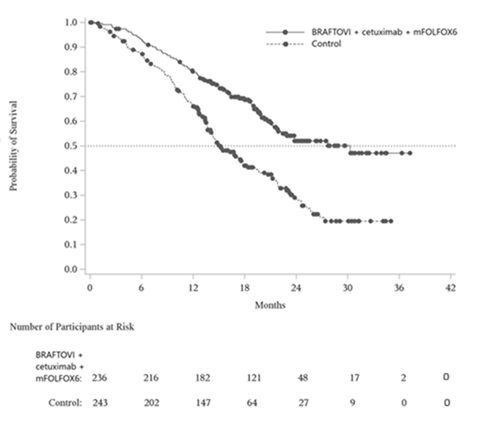
BRAFTOVI in combination with cetuximab and mFOLFOX6 demonstrated statistically significant improvements in ORR, PFS, and OS compared to the active comparator. Efficacy results are summarized in Table 16.
| CI = Confidence interval; CR = Complete response; DoR = Duration of response; N = Number of patients; NE = Not estimable; ORR = Objective response rate; PR = Partial response; HR = Hazard ratio; OS = Overall survival; PFS = Progression-free survival. | ||
| ||
Efficacy Parameter | BRAFTOVI with cetuximab and mFOLFOX6 N=236 | mFOLFOX6 ± bevacizumab or FOLFOXIRI ± bevacizumab or CAPOX ± bevacizumab N=243 |
Progression-Free Survival | ||
Number of events (%) | 122 (52) | 132 (54) |
Progressive disease | 105 (45) | 109 (45) |
Death | 17 (7) | 23 (9) |
Median PFS, months (95% CI) | 12.8 (11.2, 15.9) | 7.1 (6.8, 8.5) |
0.53 (0.41, 0.68) | ||
<0.0001 | ||
Objective Response Rate§ | ||
ORR (95% CI) | 61% (52%, 70%) | 40% (31%, 49%) |
CR | 2.7% | 1.8% |
PR | 58% | 38% |
0.0008 | ||
Duration of Response§ | ||
Median DoR, months (95% CI) | 13.9 (8.5, NE) | 11.1 (6.7, 12.7) |
Overall Survival# | ||
Number of events (%) | 94 (40%) | 148 (61%) |
Median OS, months (95% CI) | 30.3 (21.7, NE) | 15.1 (13.7, 17.7) |
0.49 (0.38, 0.63) | ||
<0.0001 | ||
- Figure 2: Kaplan-Meier Curves for Progression-Free Survival in BREAKWATER (BRAFTOVI plus cetuximab and mFOLFOX6)
- Figure 3: Kaplan-Meier Curves for Overall Survival in BREAKWATER (BRAFTOVI plus cetuximab and mFOLFOX6)
BREAKWATER - BRAFTOVI with Cetuximab and FOLFIRI
BRAFTOVI in combination with cetuximab and FOLFIRI (fluorouracil, leucovorin and irinotecan) was evaluated in a separate cohort (Cohort 3) of BREAKWATER CRC (NCT04607421).
Patients were randomized 1:1 to one of the following treatment arms:
- •
- BRAFTOVI 300 mg orally once daily in combination with cetuximab 500 mg/m2 IV infusion every 2 weeks and FOLFIRI every 2 weeks (BRAFTOVI+cetuximab+FOLFIRI arm)
- •
- FOLFIRI (every 2 weeks) with or without bevacizumab (administered per prescribing instructions)
FOLFIRI consisted of irinotecan 180 mg/m2 (90 minute IV infusion); leucovorin 400 mg/m2 (120 minute IV infusion); and 5-FU (400 mg/m2 IV bolus, then 5-FU 2400 mg/m2 continuous IV infusion over 46 - 48 hours).
Treatment continued until disease progression, unacceptable toxicity, withdrawal of consent, lost to follow-up, or death.
The major efficacy outcome measure was confirmed objective response rate (ORR) as assessed by BICR. An additional efficacy outcome measure included duration of response (DoR) as assessed by BICR.
A total of 73 patients were randomized to the BRAFTOVI+cetuximab+FOLFIRI arm and 74 to the control arm. Of these patients, the median age was 62 years, 54% were female, 61% were White, 33% were Asian, 1.4% were Native Hawaiian or Other Pacific Islander, 0.7% were Multiracial, and 3.4% were not reported; 10% were Hispanic or Latino, 83% were not Hispanic or Latino, and 7% were not reported. There were no Black or African American patients enrolled in Cohort 3 of BREAKWATER. Sixty percent (60%) had baseline ECOG performance status of 0.
BRAFTOVI in combination with cetuximab and FOLFIRI demonstrated a statistically significant improvement in ORR compared to the active comparator. Efficacy results are summarized in Table 17.
| CI = Confidence interval; CR = Complete response; DoR = Duration of response; N = Number of patients; ORR = Objective response rate; PR = Partial response. | ||
| ||
Efficacy Parameter | BRAFTOVI with cetuximab and FOLFIRI N=73 | FOLFIRI with or without bevacizumab N=74 |
Objective Response Rate | ||
ORR (95% CI) | 64% (53%, 74%) | 39% (29%, 51%) |
CR | 4.1% | 1.4% |
PR | 60% | 38% |
P-value* | 0.0011 | |
Duration of Response | ||
% with DoR ≥6 months | 57% | 35% |
BEACON CRC-BRAFTOVI with Cetuximab following prior therapy
BRAFTOVI in combination with cetuximab was evaluated in a randomized, active-controlled, open-label, multicenter trial (BEACON CRC; NCT02928224). Eligible patients were required to have BRAF V600E mutation-positive metastatic colorectal cancer (CRC), as detected using the Qiagen therascreen BRAF V600E RGQ polymerase chain reaction (PCR) Kit, with disease progression after 1 or 2 prior regimens. Other key eligibility criteria included absence of prior treatment with a RAF, MEK, or EGFR inhibitor, eligibility to receive cetuximab per local labeling with respect to tumor RAS status, and ECOG performance status (PS) 0-1. Randomization was stratified by Eastern Cooperative Oncology Group (ECOG) performance status (0 versus 1), prior use of irinotecan (yes versus no), and cetuximab product used (US‑licensed versus EU-authorized).
Patients were randomized 1:1:1 to one of the following treatment arms:
- •
- BRAFTOVI 300 mg orally once daily in combination with cetuximab (BRAFTOVI/cetuximab arm)
- •
- BRAFTOVI 300 mg orally once daily in combination with binimetinib and cetuximab
- •
- Irinotecan with cetuximab or FOLFIRI with cetuximab (control arm)
The dosage of cetuximab in all patients was 400 mg/m2 intravenously for the first dose followed by 250 mg/m2 weekly.
Patients in the control arm received cetuximab with either irinotecan 180 mg/m2 intravenously on Days 1 and 15 of each 28‑day cycle or FOLFIRI intravenously (irinotecan 180 mg/m2 on Days 1 and 15; folinic acid 400 mg/m2 on Days 1 and 15; then 5-FU 400 mg/m2 bolus on Days 1 and 15 followed by 5-FU 2400 mg/m2/day by continuous infusion over 2 days).
Treatment continued until disease progression or unacceptable toxicity. Only the results of the approved regimen (BRAFTOVI in combination with cetuximab) are described below.
The major efficacy outcome measure was overall survival (OS). Additional efficacy outcome measures included progression-free survival (PFS), overall response rate (ORR), and duration of response (DoR) as assessed by blinded independent central review (BICR). OS and PFS were assessed in all randomized patients. ORR and DoR were assessed in the subset of the first 220 patients included in the randomized portion of the BRAFTOVI/cetuximab and control arm of the study.
A total of 220 patients were randomized to the BRAFTOVI/cetuximab arm and 221 to the control arm. Of these 441 patients, the median age was 61 years; 53% were female; 80% were White, 15% were Asian, and 5% were other or not reported. Four percent (4%) were Hispanic or Latino, 90% were not Hispanic or Latino, and 6% were not reported or unknown. Fifty percent (50%) had baseline ECOG performance status of 0; 66% received 1 prior therapy and 34% received 2; 93% received prior oxaliplatin and 52% received prior irinotecan.
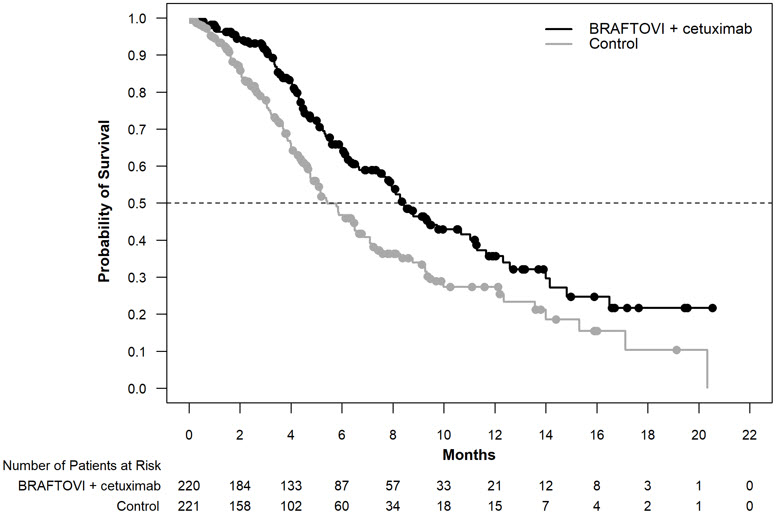
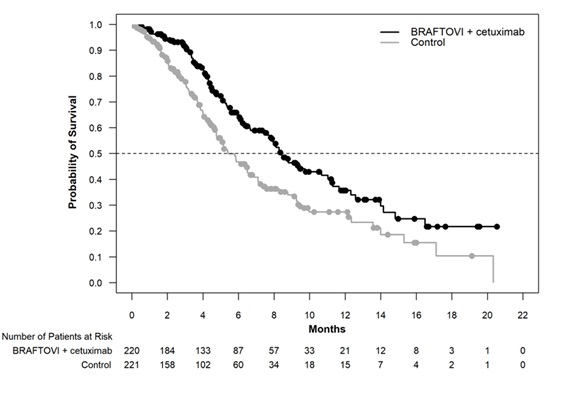
BRAFTOVI in combination with cetuximab demonstrated a statistically significant improvement in OS, ORR, and PFS compared to the active comparator. Efficacy results are summarized in Table 18 and Figure 4
| CI = Confidence interval; CR = Complete response; DoR = Duration of response; HR = Hazard ratio; NR = Not reached; ORR = Overall response rate; OS = Overall survival; PFS = Progression-free survival; PR = Partial response. | ||
| ||
BRAFTOVI with cetuximab N=220 | Irinotecan with cetuximab or FOLFIRI with cetuximab N=221 | |
Overall Survival | ||
Number of Events (%) | 93 (42) | 114 (52) |
Median OS, months (95% CI) | 8.4 (7.5, 11.0) | 5.4 (4.8, 6.6) |
0.60 (0.45, 0.79) | ||
0.0003 | ||
Overall Response Rate (per BICR) | ||
ORR (95% CI)§ | 20% (13%, 29%) | 2% (0%, 7%) |
CR | 5% | 0% |
PR | 15% | 2% |
<0.0001 | ||
Median DoR, months (95% CI) | 6.1 (4.1, 8.3) | NR (2.6, NR) |
Progression‑Free Survival (per BICR) | ||
Number of events (%) | 133 (60) | 128 (58) |
Progressive disease | 110 (50) | 101 (46) |
Death | 23 (10) | 27 (12) |
Median PFS, months (95% CI) | 4.2 (3.7, 5.4) | 1.5 (1.4, 1.7) |
0.40 (0.31, 0.52) | ||
<0.0001 | ||
Figure 4: Kaplan-Meier Curves for Overall Survival in BEACON CRC
14.3 BRAF V600E Mutation-Positive Metastatic Non-Small Cell Lung Cancer
BRAFTOVI in combination with binimetinib was evaluated in an open-label, multicenter, single-arm study in patients with BRAF V600E mutation-positive metastatic non-small cell lung cancer (NSCLC) (PHAROS; NCT03915951). Eligible patients had a diagnosis of histologically-confirmed metastatic NSCLC with BRAF V600E mutation that was treatment-naïve or had been previously treated with 1 prior line of systemic therapy in the metastatic setting (platinum-based chemotherapy and/or anti-PD-1/PD-L1 therapies), age 18 years or older, Eastern Cooperative Oncology Group (ECOG) performance status (PS) of 0 or 1, and measurable disease as defined by Response Evaluation Criteria in Solid Tumors (RECIST) v1.1. Prior use of BRAF inhibitors or MEK inhibitors was not allowed.
Patients received BRAFTOVI 450 mg once daily and binimetinib 45 mg orally twice daily until disease progression or unacceptable toxicity. The major efficacy outcome measures were objective response rate (ORR) per RECIST v1.1 and duration of response (DoR) as assessed by independent review committee (IRC).
In the efficacy population, BRAF V600E mutation status was determined by prospective local testing using tumor tissue (78%) or blood (22%) specimens. Of the 98 patients with BRAF V600E mutation, 6 patients were enrolled into the trial based on testing of their tumor tissue specimens with the FoundationOne CDx tissue test. Of the remaining 92 patients enrolled based on local testing, 68 patients had their tumor tissue specimens retrospectively confirmed as having BRAF V600E positive status by the FoundationOne CDx tissue test. The remaining patients had either BRAF V600E negative status (n=5) or had unevaluable results (n=19) by the FoundationOne CDx tissue test. In addition, plasma samples from 81 out of 98 patients were retrospectively tested using the FoundationOne Liquid CDx assay. Of the 81 patients, 48 were confirmed positive for BRAF V600E, while 33 patients were BRAF V600E mutation negative by FoundationOne Liquid CDx assay. The remaining 17 samples had unevaluable results with FoundationOne Liquid CDx assay.
The efficacy population included 59 treatment-naïve patients and 39 previously-treated patients. Among these 98 patients, the median age was 70 years (range: 47 to 86); 53% female; 88% White, 7% Asian, 3% Black or African American, and 1% American Indian or Alaska Native; 99% were not Hispanic or Latino; 13% were current smokers and 57% were former smokers; 73% had ECOG PS of 1; and 97% had adenocarcinoma. All patients had metastatic disease, and 8% had brain metastases at baseline.
Efficacy results for patients with BRAF V600E mutation-positive metastatic NSCLC are summarized in Table 19.
| CI = Confidence interval; CR = Complete response; DoR = Duration of response; N = Number of patients; NE = Not estimable; ORR = Objective response rate; PR = Partial response. | ||
BRAFTOVI with binimetinib | ||
Efficacy Parameter | Treatment‑naïve (N=59) | Previously‑treated (N=39) |
Objective Response Rate* | ||
ORR (95% CI) | 75% (62, 85) | 46% (30, 63) |
CR | 15% | 10% |
PR | 59% | 36% |
N=44 | N=18 | |
Range in months | 1.4, 51.6+ | 3.8, 45.8+ |
% with DoR ≥12 months | 64% | 44% |
% with DoR ≥24 months | 43% | 22% |
MEDICATION GUIDE
MEDICATION GUIDE | |||
Important information: BRAFTOVI is used in combination with other medicines, including binimetinib, cetuximab, or cetuximab and fluorouracil-based chemotherapy. Read the Medication Guide that comes with binimetinib if BRAFTOVI is used with binimetinib. Talk to your healthcare provider about cetuximab, or cetuximab and mFOLFOX6 or FOLFIRI if used with BRAFTOVI. | |||
What is the most important information I should know about BRAFTOVI? Risk of new skin cancers. BRAFTOVI can cause skin cancers called cutaneous squamous cell carcinoma or basal cell carcinoma.
Your healthcare provider should check your skin before treatment with BRAFTOVI, every 2 months during treatment, and for up to 6 months after you stop treatment with BRAFTOVI to look for any new skin cancers. Your healthcare provider should also check for cancers that may not occur on the skin. Tell your healthcare provider about any new symptoms that develop during treatment with BRAFTOVI. See "What are the possible side effects of BRAFTOVI?" for more information about side effects. | |||
What is BRAFTOVI?
BRAFTOVI should not be used to treat people with wild-type‑BRAF melanoma, wild-type‑BRAF colorectal cancer, or wild-type‑BRAF NSCLC. Your healthcare provider will perform a test to make sure that BRAFTOVI is right for you. | |||
Before taking BRAFTOVI, tell your healthcare provider about all of your medical conditions, including if you:
Tell your healthcare provider about all the medicines you take, including prescription and over-the-counter medicines, vitamins, and herbal supplements. | |||
How should I take BRAFTOVI?
| |||
What are the possible side effects of BRAFTOVI?
| |||
| |||
Your healthcare provider may change your dose, temporarily stop, or permanently stop treatment with BRAFTOVI if you have certain side effects. The most common side effects of BRAFTOVI when taken in combination with binimetinib for melanoma include:
The most common side effects of BRAFTOVI when taken in combination with cetuximab and mFOLFOX6 for colorectal cancer include: | |||
|
| ||
The most common side effects of BRAFTOVI when taken in combination with cetuximab and FOLFIRI for colorectal cancer include: | |||
|
| ||
The most common side effects of BRAFTOVI when taken in combination with cetuximab for colorectal cancer include: | |||
|
| ||
The most common side effects of BRAFTOVI when taken in combination with binimetinib for NSCLC include: | |||
|
| ||
BRAFTOVI may cause fertility problems in males. This may affect your ability to father a child. Talk to your healthcare provider if this is a concern for you. These are not all of the possible side effects of BRAFTOVI. Call your doctor for medical advice about side effects. You may report side effects to FDA at 1-800-FDA-1088. You may also report side effects to Pfizer Inc. at 1-800-438-1985. | |||
How should I store BRAFTOVI?
Keep BRAFTOVI and all medicines out of the reach of children. | |||
General information about the safe and effective use of BRAFTOVI. | |||
What are the ingredients in BRAFTOVI? | |||
This Medication Guide has been approved by the U.S. Food and Drug Administration. Revised: 02/2026
Additional Resources
Chat online with Pfizer Medical Information regarding your inquiry on a Pfizer medicine or vaccine.
Speak with a Pfizer Medical Information Professional regarding your Pfizer medicine or vaccine inquiry.
Available 9AM-5PM ET Monday to Friday; excluding holidays.
Submit a medical question for a Pfizer medicine or a vaccine.
The submission will be reviewed during our standard business hours.
To report an adverse event related to a Pfizer product and you are not part of a clinical trial* for this medication, click the link below to submit your information:
Pfizer Safety Reporting Site
*If you are involved in a clinical trial for either product, adverse events should be reported to your coordinating study site.
If you cannot use the above website to report an adverse event related to a Pfizer medication, please call (800) 438-1985.
You may also contact the U.S. Food and Drug Administration (FDA) directly to report adverse events or product quality concerns either online at www.fda.gov/medwatch or by calling (800) 332-1088.